
Mike and Mary Clark
When Mike returned from the war, he met his soulmate, Mary (Rieland). They wed on August 28th, 1971, after Mike’s red afro and dry sense of humor won her over. The dedication and loyalty Mike learned in Vietnam continued into his marriage. They celebrated over 50 years together, during which time they raised a family, shared moments of laughter, and navigated life's challenges before Mike passed away at age 78.
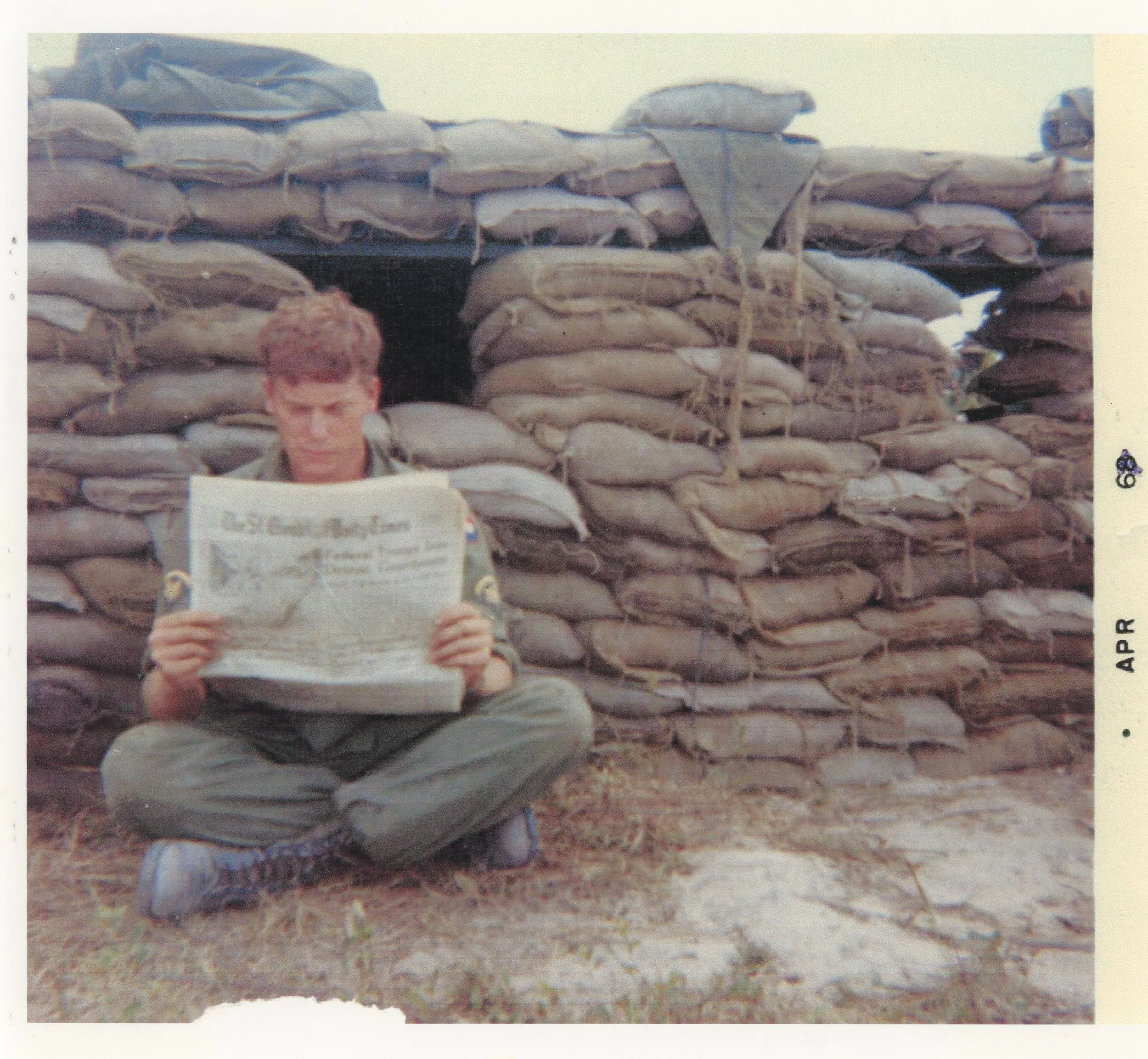
Mike reading the St. Cloud newspaper while serving in Vietnam. (ID# 2024.1137.004)
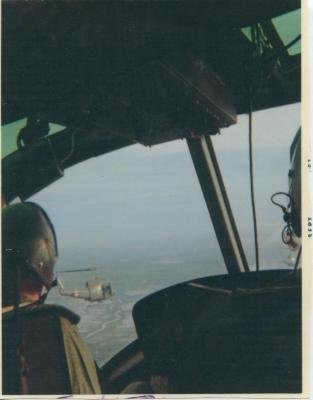
Aerial image of the Mekong Delta, Vietnam, taken from a Huey helicopter, August 1967, taken by SP-5 Mike Clark, Chief Medic, Company A, First Platoon, Fourth Battalion, 39th Infantry, 9th Infantry Division, during a combat assault mission. There were eight infantrymen on each Huey helicopter.
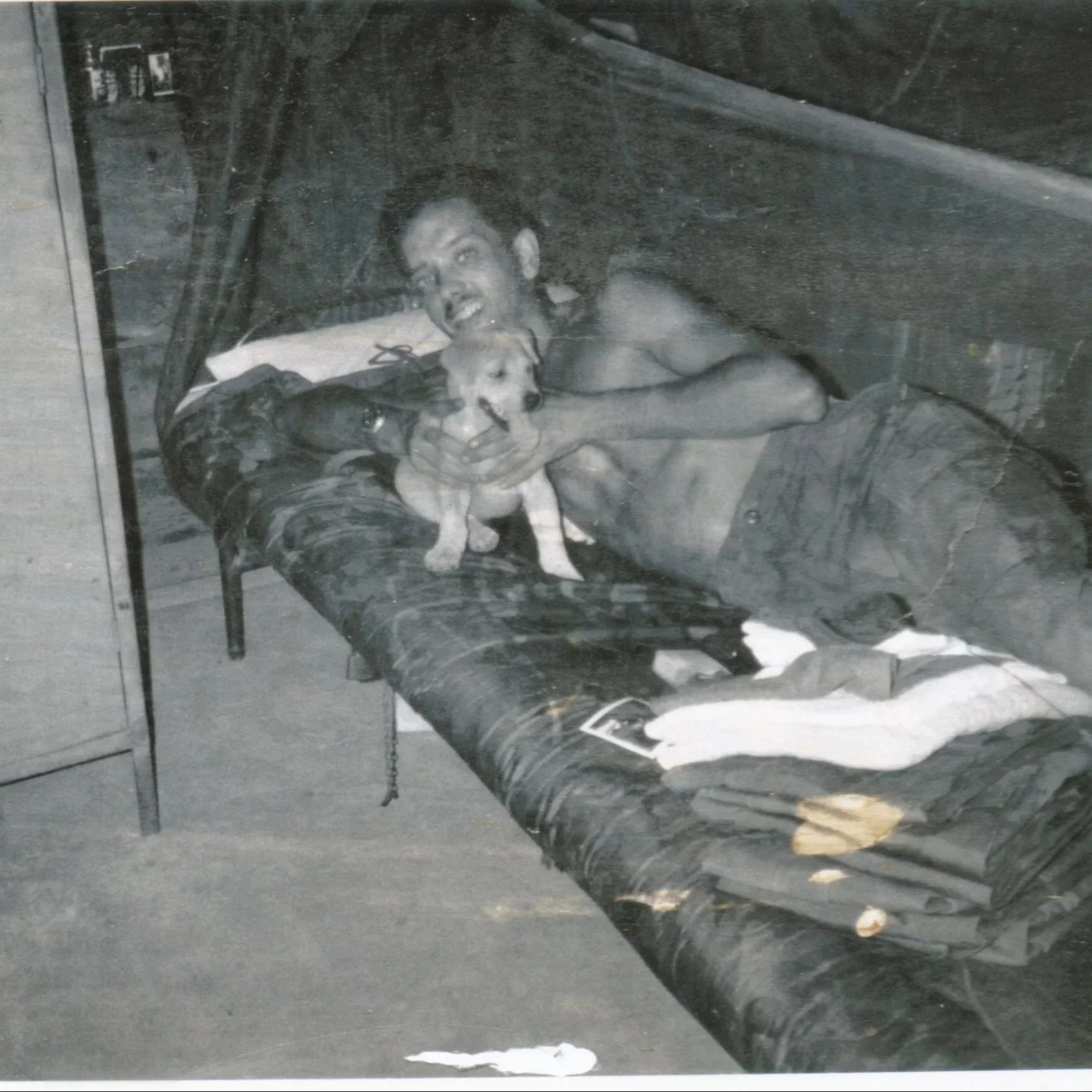
Mike and Mary wedding photo
A Time of Healing
Veterans like Mike carry the mental scars of war, but they also carry physical ones. In Mike’s case, he would come to lose his leg as a result of the shrapnel he took from a booby trap.
questions to answer here…….
reintegration:
The action or process of integrating someone back into society: "soldiers are beginning the process of reintegration into civil society."
The action or process of restoring elements regarded as disparate to unity: "the reintegration of art into everyday life."
Do you know anyone who has deployed overseas and come home again? Were they different? Were you different? What felt really hard, and what was easier than you expected? How did different people deal with the change?
Digging Deeper
Staying married when one partner is a veteran presents unique challenges. Some couples break up, and some stay together. What do you think of the strategies below?
Open Communication: Have honest and open discussions about feelings, experiences, and challenges, especially when discussing adjustments related to military service.
Support Each Other: Veterans may face specific issues like PTSD, physical injuries, or reintegration challenges. The non-veteran partner needs to offer support and encouragement in seeking professional help when needed.
Shared Experiences: Engage in activities together to strengthen the bond between partners. Finding common interests or new hobbies can create opportunities for connection.
Education and Understanding: Learning about military life and its impact on veterans can help the non-veteran partner gain insights into their spouse’s experiences and challenges.
Building a Support Network: Connect with other veteran families to create a support system. It can be helpful to share experiences and resources.
Focus on the Positive: Celebrate milestones and achievements, both big and small, to maintain a positive outlook on the relationship.
Establish Boundaries: It’s important for both partners to maintain their own identities and interests outside the relationship, which can help prevent feelings of isolation.
Plan for the Future: Setting shared goals and planning together can strengthen commitment to each other.
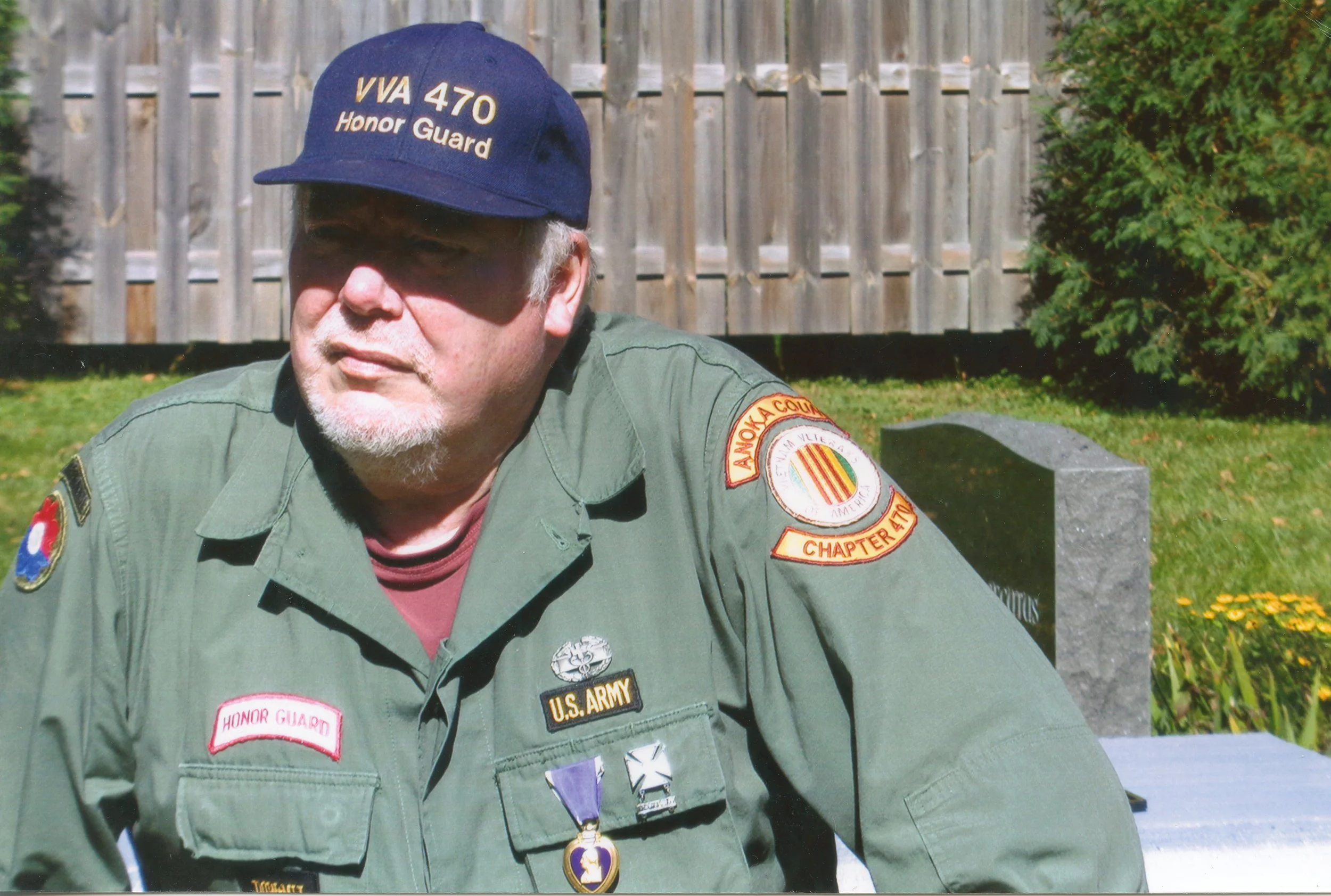
Mike Clark in his VVA 470 Honor Guard uniform, ca. 2016. (ID# 2017.1137.010)
Mike Clark
Originally from Saint Cloud, MN, he was an infantry combat medic in the US Army and served in South Vietnam from January to September 1967. His time in-country was spent deep in the Mekong Delta with the 9th Infantry Division. He spent most of his service as the head medic in his company, but his deployment was cut abruptly short when he was injured in action by a fragmentation grenade. After he returned to the US, he was one of the charter members of the Vietnam Veterans of America Chapter 470, where he volunteered with the Honor Guard.
Mike was born in La Trove, Pennsylvania, but his family shortly thereafter moved to Minnesota after his father, a cab driver, was robbed by an armed man. Mike’s family, including three younger siblings, ended up in St. Cloud, where his mother’s family was originally from. He graduated from St. Cloud High School in 1965 and joined the Army directly after. “I wanted to get out of town,” he later recalled. “I wasn’t getting along too well with my mom, and I guess I figured out during my senior year that the Navy was out because I got seasick once on Mille Lacs Lake, so that didn’t look too promising. And I figured the Air Force – it seemed to me the smarter guys went in the Air Force, so then it was down to the Army and the Marines, and at that time, they had a quota system in Stearns County, so the Marines told me they couldn’t take me till July, and so I went to the Army and, of course, they could take me anytime I wanted to leave, so I took all my tests and everything, and June 14th I was gone.”
Unable to decide on a specialty, Mike told the Army that they could choose for him. He was originally slated to be an operating room corpsman and was sent to Fort Sam Houston in San Antonio, Texas, for medical training. While there, he volunteered to serve as a combat medic instead. After completing his training, he was sent to Fort Riley, Kansas, to join the Ninth Infantry Division, and in December of 1966, he was on his way to Vietnam. His division arrived in Vung Tau, South Vietnam, in January of 1967, where he was immediately met with a ghastly sight.
“...the Australians were at Vung Tau, and they had arranged a little bit of a joke, which was really not so funny. They had two Viet Cong bodies tied to trees with a sign between them saying, ‘Welcome Yanks!’ And you know – I’m looking around saying, ‘Jesus. If this is my first day here, what’s the rest of it gonna be like?’”
Mike’s unit operated out of Bearcat Base in Bien Hoa, South Vietnam, nestled on the outskirts of the Mekong Delta. As soon as he arrived at Bearcat, he started going out on combat patrols in the immediate area. In February of 1967, Mike and the rest of his unit participated in Operation Junction City, one of the largest US operations in the entire war. During that operation, Mike patrolled both the Delta's marshes and the jungles of Southeast Vietnam. “...of the two areas, I hated the Delta the most because we’d go in there, and you’d be – sometimes you’d be in these rice paddy fields up to your waist in muck, and it stunk, and the mud hardened like cement and the sun was merciless, and I just didn’t like the Delta. Now, the jungles – at least you weren’t in mud up to your waist. Sure, you had the terrible heat and humidity, but you were out of the sun, too, in the jungle.”
In September of 1967, Mike’s platoon was on patrol when they were ambushed. He was wounded in the legs by shrapnel from a fragmentation grenade and evacuated by helicopter to the 24th Evacuation Hospital in Long Binh. From there, he was sent to Japan for further medical treatment, and then he returned to the US in October of 1967. He spent the remainder of his enlistment at Fort Riley and was discharged from the Army on June 14th, 1968. He started going to school to become a physical therapist, during which time he met his wife, Mary. Mike ultimately decided that physical therapy was not for him, so he earned his bachelor’s degree in history from Macalester College and later a master’s degree in information media from St. Cloud State University. He worked as a school media specialist for 24 years. Mike was one of the charter members of the Vietnam Veterans of America Chapter 470.
“It was started in 1989 by Dick Bergling, and I joined,” he recalled in 2003. “The first thing we did that really bonded everyone was in December of ’89 – well, let’s go to October of ’89, Jacob Wetterling was abducted, and so I wanted to do something to keep that case in the public, and in December of 1989, over three days, including Christmas, we walked from Anoka to St. Joseph, Minnesota, to publicize Jacob’s plight and keep that thing going. And we finished up our 60-mile walk Christmas Day of 1989 at the Wetterling house. And every year since then, we’ve had a walk in December for missing, abducted kids.”
Mike was a member of the 470’s ceremonial Honor Guard, which provided funeral services for late veterans of the Vietnam War. His traumatic experiences in Vietnam followed him throughout his life; his right leg was eventually amputated because of the injuries he had sustained, and he struggled with Post-Traumatic Stress Disorder. “Vietnam was an insane asylum, and you had to become one of the inmates if you were going to survive. Being there changed my life. I think a lot of people were changed by it, but being with the infantry, treating these wounds, being in these fire fights, wading these swamps, living in the jungle, living in the monsoon rains, having our fatigues rot off of us, and having the supply chopper kick off fatigues off and trying putting new ones on, eating c-rations all the time, it’s something I’ll never forget.”
Mike and Mary Clark had two sons and remained active members of the Anoka County Historical Society. Mike participated in an oral interview with ACHS in 2003, and Mary participated in one in 2024 and again in 2025. Mike passed away on March 22, 2025, at the age of 78.