
Myron Carpenter
Myron Carpenter, of Pine City, MN, served as a helicopter door gunner in the US Army and was stationed in South Vietnam from 1969 to 1970 after being drafted. He spent his tour in-country in and around Phu Bai, just about 75 miles south of the Demilitarized Zone, in the 101st Aviation Battalion of the 101st Airborne Division. He was discharged from the military in 1971.
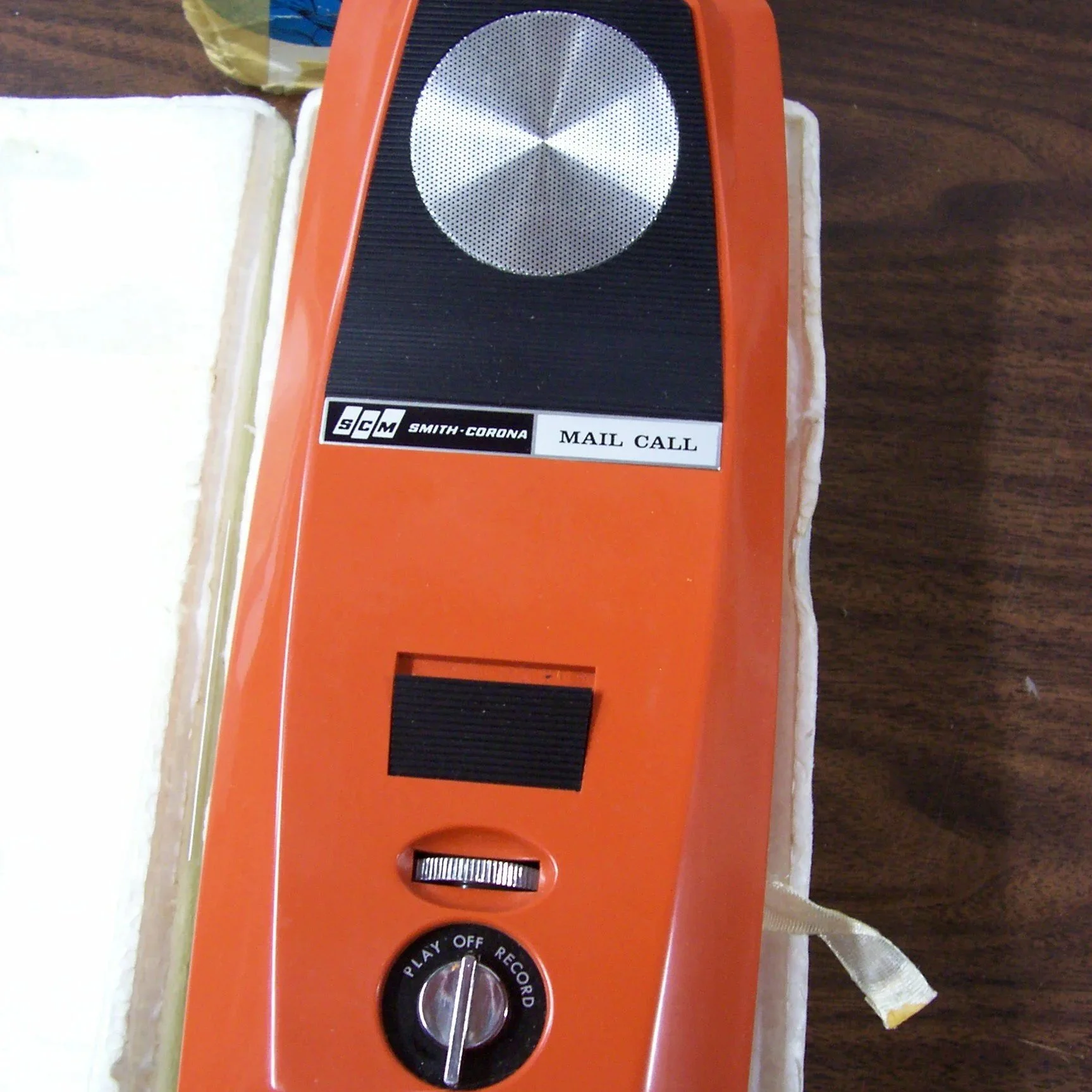
Smith-Corona "Mail Call" voice cassette recorder, ca. 1960's. The device is slim, orange, and made from hard plastic with slots for 4 “C” batteries a cassette tape. This belonged to Sam so he could record letters home. (Object ID 2531)
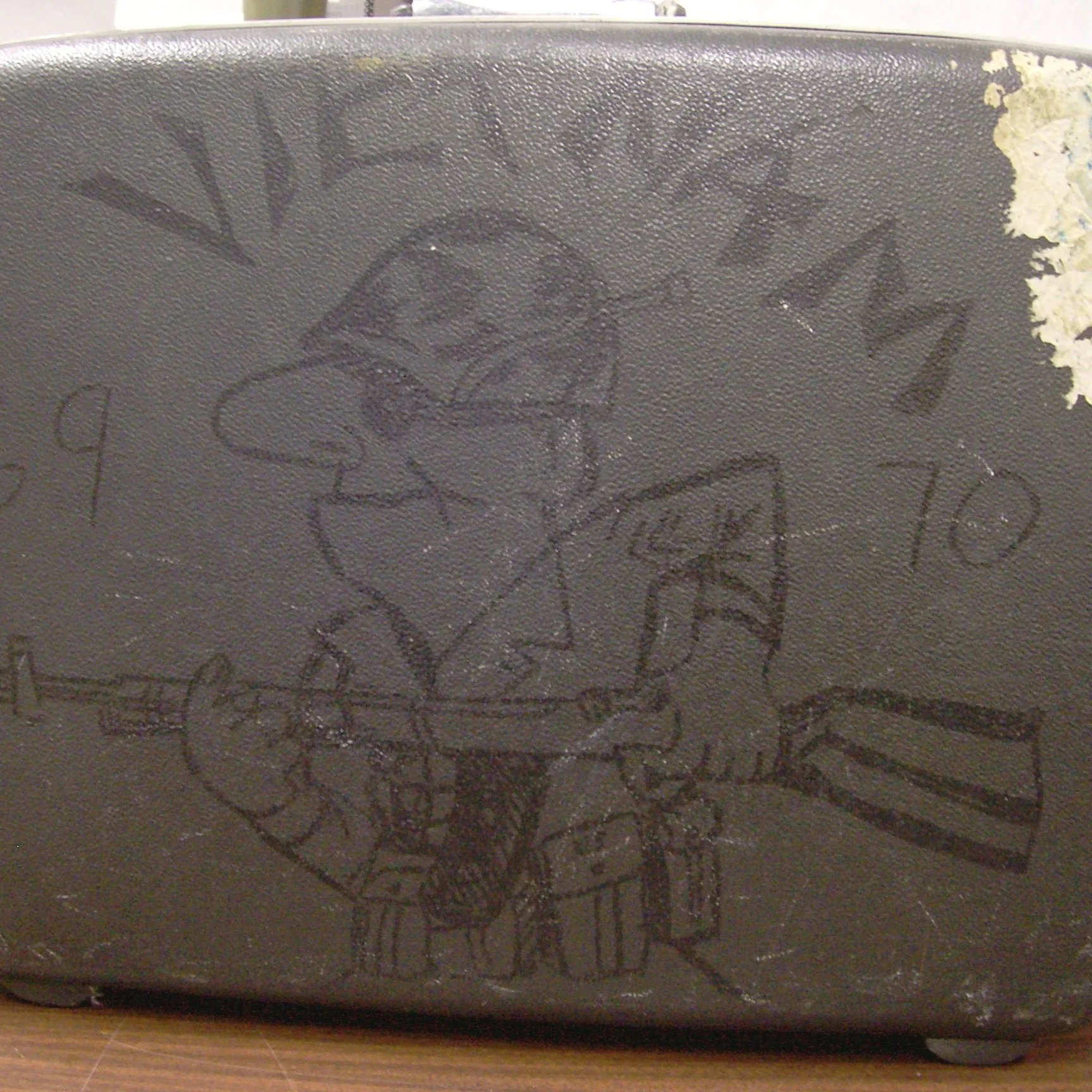
After his tour in Vietnam, Sam sat at a train station in Weisbotton, Germany for RR (rest and relaxation) when a fellow soldier drew “trench art” pictures using a magic marker on both sides of his suitcase. (Object ID 2007.1390.002)
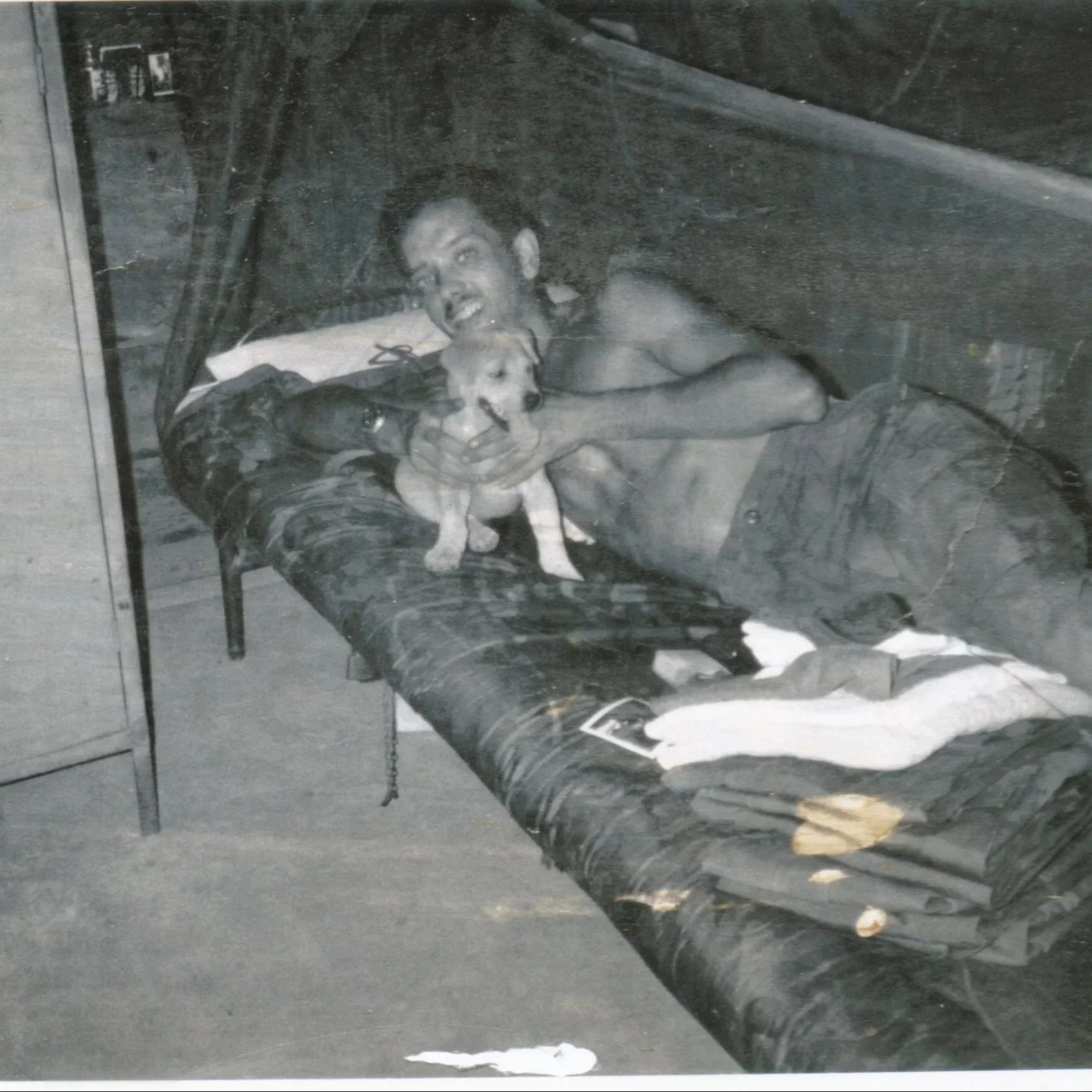
Sam made the most of every situation, including befriending a stray dog in Lai Khevn, Vietnam in 1969. Notice the mosquito netting he rolled up around his bunk, which is inside a large tent. (Object ID P2069.6.30)
The Draft
It’s time to pretend you’re part of Sam’s social circle. Who will you be? You can choose one of the following:
Mother
Father
Sister
Friend
You just received an envelope in the mail from Sam. Before you read it, think about how it feels to see his handwriting. How does the paper feel in your hands? What were the last things you knew about his time in Vietnam? What do you hope to learn in this letter?
Censorship and Self-Censorship
Letters were often censored by military authorities to prevent the disclosure of sensitive information. Soldiers also practiced self-censorship, avoiding details that might worry their loved ones or reveal military operations.
What type of information do you think Sam keep from you? What would he be worried about you knowing? What should YOU not tell HIM so he doesn’t get in trouble or worry about life at home? Does this feel like lying to you?
Open the letter Sam sent you and read it. Think about what he shared, then write back to Sam.
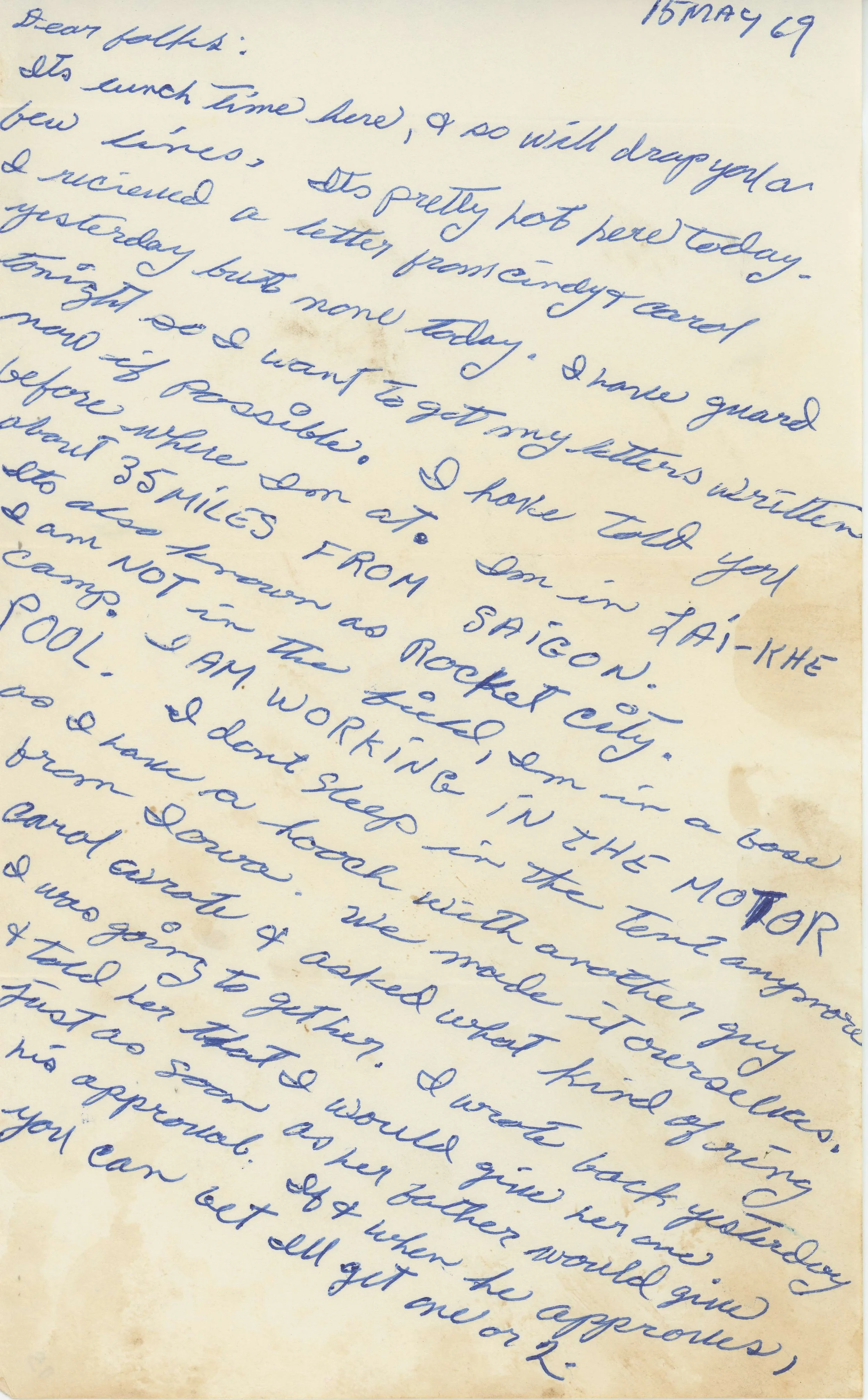
May 15, 1969
Dear folks,
It’s lunch time here, so will drop you a few lines. It’s pretty hot here today. I received a letter from Cindy + Carol yesterday but none today. I have guard tonight so I want to get my letters written now if possible. I have told you before where I am at. I’m in LAI-KHE about 35 MILES FROM SAIGON. It’s also known as Rocket City. I am NOT in the field, I’m in a base camp. I AM WORKING IN THE MOTOR POOL. I don’t sleep in the tent anymore as I have a hooch with another guy from Iowa. We made it ourselves. Carol wrote + asked what kind of ring I was going to get her. I wrote back yesterday + told her that I would give her one just as soon as her father would give his approval. If + when he approves you can bet I’ll get one or 2.
There isn’t much else I can tell you. She asked if I would take her out + get her drunk when I get back. I told her that there is no pleasure in it. I said that enough to make you feel good is ok, but not enough to make you lose your senses. I told her that I have only been drunk a few times + that you get sick + next day you have a bad hangover. Some of her friends told her that its really great when you’re drunk. I told her that they forgot to include the after effects. There isn’t anything else to say so will close. Hello to everyone.
Love Sam
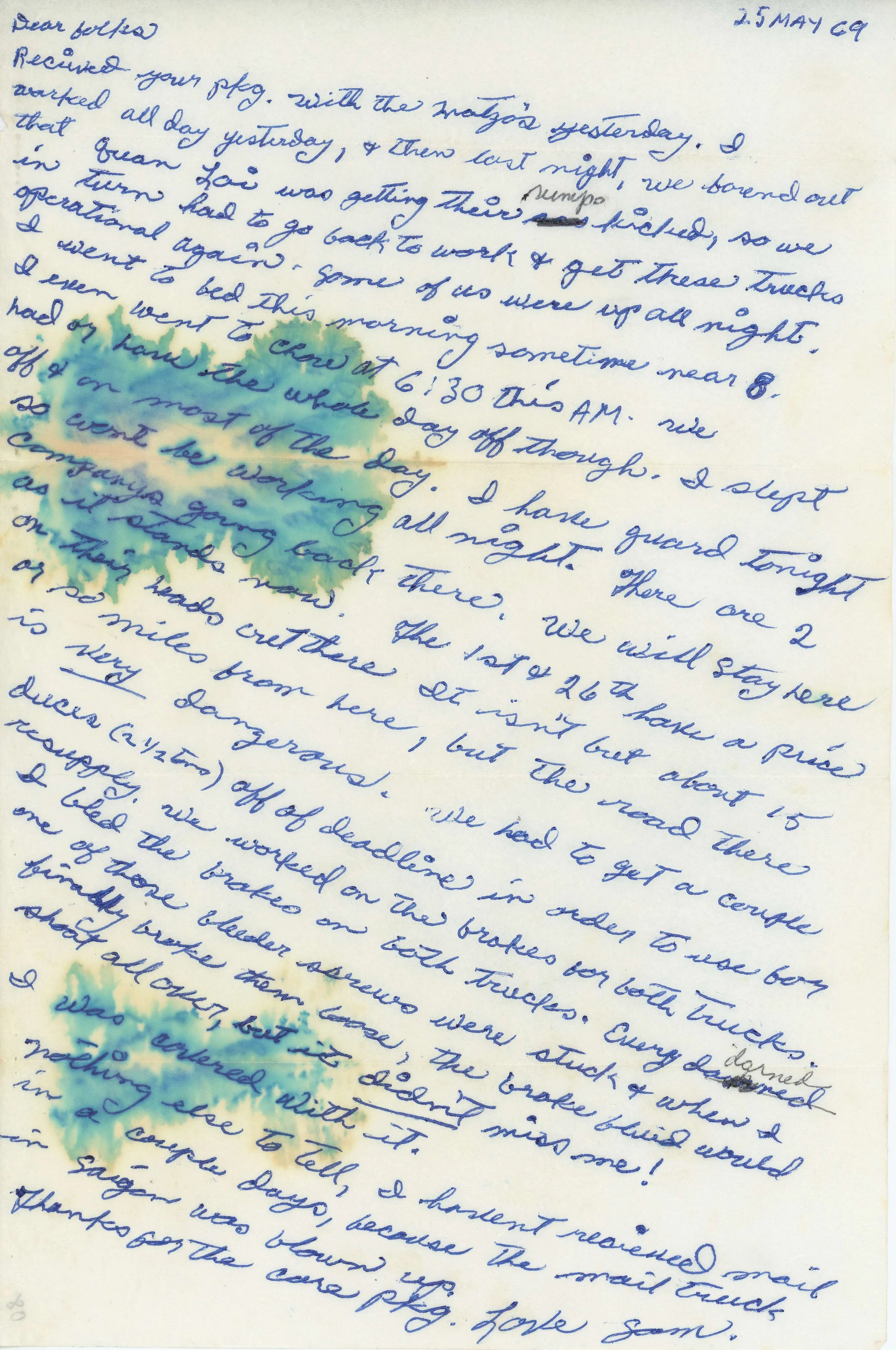
May 25th, 1969
Dear folks,
Received your pkg. with the [illegible] yesterday. I worked all day yesterday, + then last night, we found out that Quan Loi was getting their rumps kicked, so we in turn had to go back to work + get these trucks operational again. Some of us were up all night. I went to bed this morning sometime near 8. I even went to chow at 6:30 this AM. We had or have the whole day off though. I slept off and on most of the day. I have guard tonight so won’t be working all night. There are 2 companies going back there. We will stay here as it stands now. The 1st + 26th have a price on their heads out there. It isn’t but about 15 or so miles from here, but the road there is very dangerous. We had to get a couple deuces off of deadline in order to use for resupply. We worked on the brakes for both trucks. I bled the brakes on both trucks. Every darned one of the bleeder screws were stuck + when I finally broke them loose, the brake fluid would shoot all over, but it didn’t miss me! I was covered with it. Nothing else to tell, I haven’t received mail in a couple days, because the mail trucks in Saigon were blown up. Thanks for the care pkg.
Love Sam
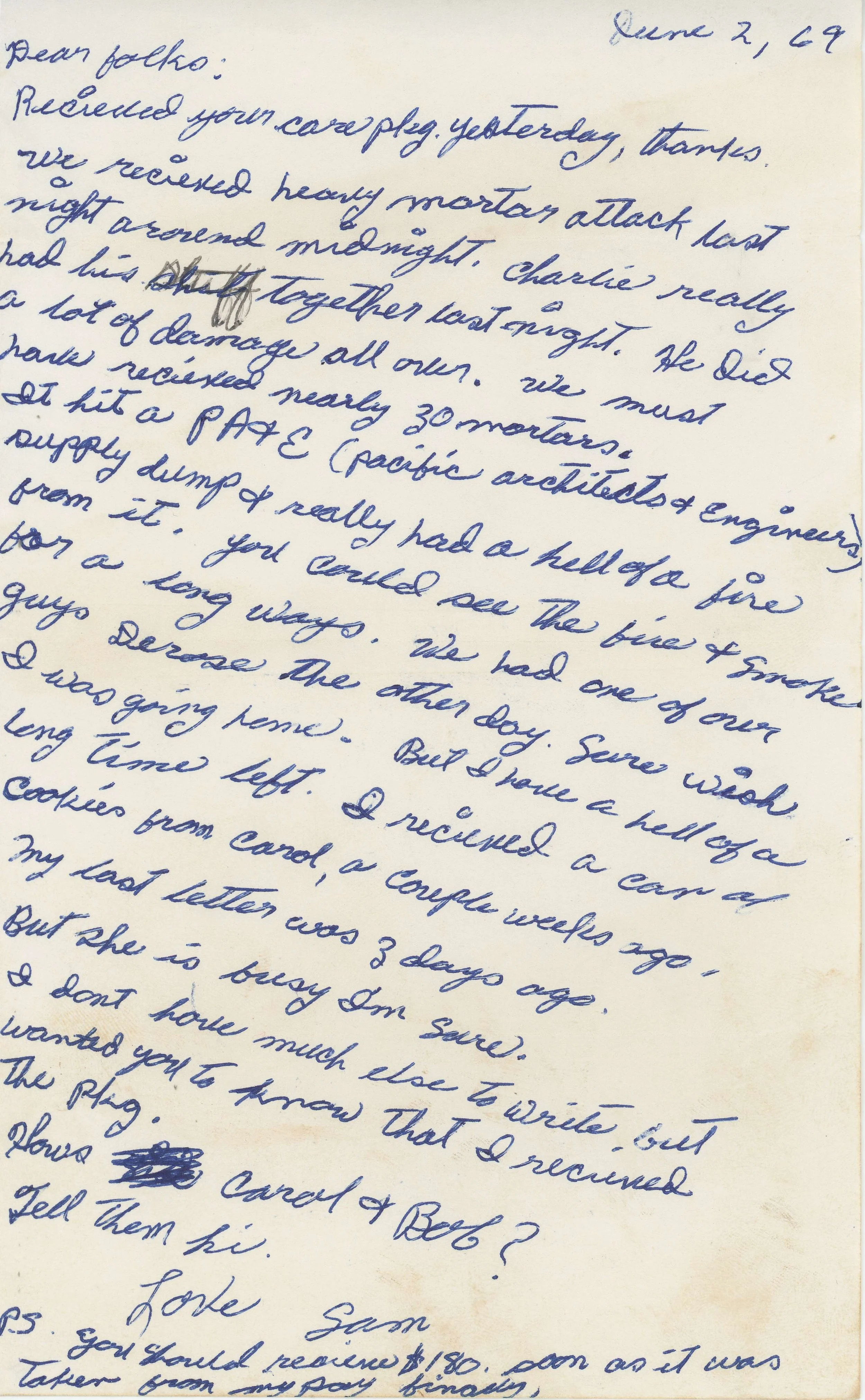
june 2, 1969
Dear folks,
Received your care pkg. yesterday, thanks. We received heavy mortar attack last night around midnight. Charlie really had his stuff together last night. He did a lot of damage all over. We must have received nearly 30 mortars. It hit a PA+E (pacific architects + engineers) supply dump + really had a hell of a fire from it. You could see the fire and smoke for a long ways. We had one of our guys [illegible] the other day. Sure wish I was going home. But I have a hell of a long time left. I received a can of cookies from Carol a couple weeks ago. My last letter was 3 days ago. But she is busy I’m sure. I don’t have much else to to write, but wanted you to know that I received the pkg. How’s Carol + Bob? Tell them hi.
Love Sam
P.S. you should receive $180 soon as it was taken from my pay finally.
Digging Deeper
Emotional Context: Soldiers often wrote under intense stress, fear, and homesickness. Their words may reflect anxiety, trauma, or attempts to reassure family members. Sometimes, they tried to downplay dangers to avoid causing distress at home.
Limited Perspective: Letters often offer a very personal, subjective view. They may not represent the full reality of the war, broader events, or the experiences of other soldiers.
Communication Delays: Letters took weeks to arrive, so events described were often already outdated. This lag could create confusion or misunderstandings between soldiers and those back home.
Cultural and Historical Context: Understanding the era’s political climate, anti-war sentiment, and soldiers’ backgrounds helps interpret the letters’ tone, content, and subtext.
Psychological Impact: War letters can reveal the psychological toll of combat, including signs of trauma, loneliness, and moral conflict, even if not stated explicitly.
Expressions of Camaraderie and Routine: Soldiers often shared stories of daily life, friendships, and mundane routines, which provided comfort and a sense of normalcy amid chaos.
Hope, Longing, and Connection: Letters were a crucial emotional lifeline. Pay attention to expressions of hope for the future, longing for home, and efforts to maintain relationships despite distance and adversity.
Myron was born and raised on a dairy farm in Pine City, Minnesota, the middle of three children. He later credited the skills and work ethic he learned on the farm with helping him survive his time in Vietnam. He attended a one-room schoolhouse for seven years before going to Pine City High School, where he graduated in 1966. He found work at a local car dealership, where he remained until receiving his draft notice in February of 1969. Getting drafted didn’t come as a surprise to him; he later recalled, “We knew it. In that era, there was no lottery system or number system, or anything. They just drafted everybody. I mean, that’s just….when you get to that age, you’re drafted.”
He was sent to Fort Campbell, Kentucky, for his eight-week basic training. “I think it [was] a good experience,” he recalled, “but it’s not easy, and in some ways, it’s not all a positive mental thing, because of the way the drill sergeants conducted it back in that era, which they no longer do now. Some would get to the point of being abusive, both verbally and emotionally, at that time, which they don’t do anymore.” He was assigned to aircraft armament, and he was sent to Fort Reed, Maryland for his Advanced Individual Training (AIT), where he was trained in “...electrical schematics of wiring the helicopters, how the drums operated. They were run on 24 volts. All the repairs of those armaments, they call it, on the helicopter. Machine guns and rocket pods, grenade launchers; so it was probably half hands-on and half classroom for the electronics and mechanics.”
Four months later, Myron boarded a seventeen-and-a-half-hour-long flight directly into Da Nang, South Vietnam, and from there went to Phu Bai. He reported to the 101st Aviation Company, 101st Aviation Battalion, 101st Airborne Division, an air assault group known as the “Black Widows.” “They had 26 Huey helicopters, six Cobras, and two of those little helicopters. By aviation assault, it means that on the Huey, you could go in and medivac people out, haul infantry men in, supplies in, and be supported by the Cobra gun ships.”
While he was trained in aviation armament, he volunteered to serve as a helicopter door gunner at his unit’s request. “And I really excelled at it. I thought I was doing the right thing, you know? I still wasn’t ready for what I really went through and saw. I don’t know if anybody
mentally or emotionally could be unless you would redo it… It’s a very close-knit group and you’re protecting your own Cobra, and obviously, taking it on yourself. And you’re hauling people that are either dead or dying, so it’s - I don’t think anybody can prepare for it.”
Myron flew on UH-1 “Huey” helicopters, which typically had a crew of four: pilot, co-pilot, crew chief, and gunner. “And obviously, the crew chief and door gunner don’t have any
control over the machine guns and armament on the helicopter. They just have control of their own machine guns on the side of the helicopter. And then they have observation roles while you’re flying, obviously, and gunner support roles while you’re flying because you’re shooting at the enemy when you’re landing and taking off to protect the aircraft and people you’re picking up.”
He flew a total of 420 hours in a combat zone, during which time he crashed twice. “One time a back chain got blown off and the helicopter went around and around and down. And the second time, something went off and it was the oxygen, so the helicopter had no air to fly, so we went straight down… The second one, the co-pilot and the crew chief died landing on that side, and me and the pilot survived. And the first one also died. It landed in the mud.” He recalled that when he arrived in Phu Bai, the US forces stationed there were losing 15 men a week. “But when I got there, I flew into Dau Bai, and there were 15 pine boxes sitting by the aircraft, so that’s a big wake up call to see them lined up. Nobody in them. They were just sitting there for the next week.”
As a “short-timer,” Myron transferred from being a door gunner to driving an ammunition truck and overseeing a supply post, where he spent the remainder of his tour. In 1970, he was sent back to the US and was briefly stationed at the Army’s Yuma Proving Grounds in Arizona, where he tested munitions being sent to Vietnam. From there, he was sent to Fort Ord, California, where he acted as a training sergeant specializing in survival training. When he was discharged from the military in 1971, he returned to his family farm and began attending the Minnesota School of Business. He found work at another car dealership and married his wife, Penny, in 1973. The two had three children together and currently live in East Bethel, Minnesota.