
Sam Hermanstorfer
Sam Hermanstorfer, originally from Minneapolis, MN, served in the US Army as a wheeled vehicle mechanic and was stationed in Vietnam from 1969 to 1970. He served in-country, assigned to the motor pool of Company B of the 701st Maintenance Battalion, first in Lai Khe and then in Dau Tieng, South Vietnam. Afterward, he spent a year stationed in West Germany and was discharged from the military in 1971. He was a member of VVA 470, where he volunteered with the Honor Guard.
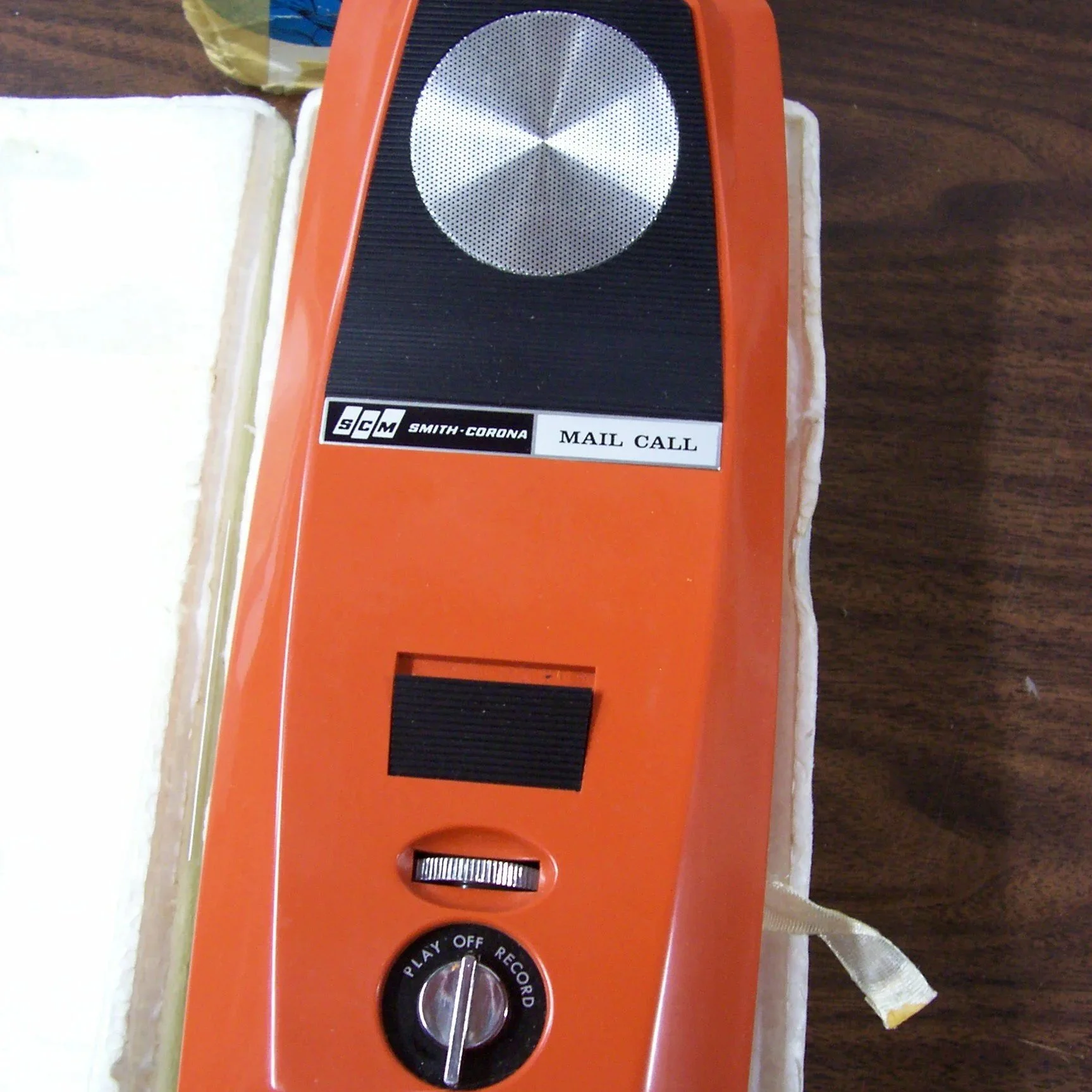
Smith-Corona "Mail Call" voice cassette recorder, ca. 1960's. The device is slim, orange, and made from hard plastic with slots for 4 “C” batteries a cassette tape. This belonged to Sam so he could record letters home. (Object ID 2531)
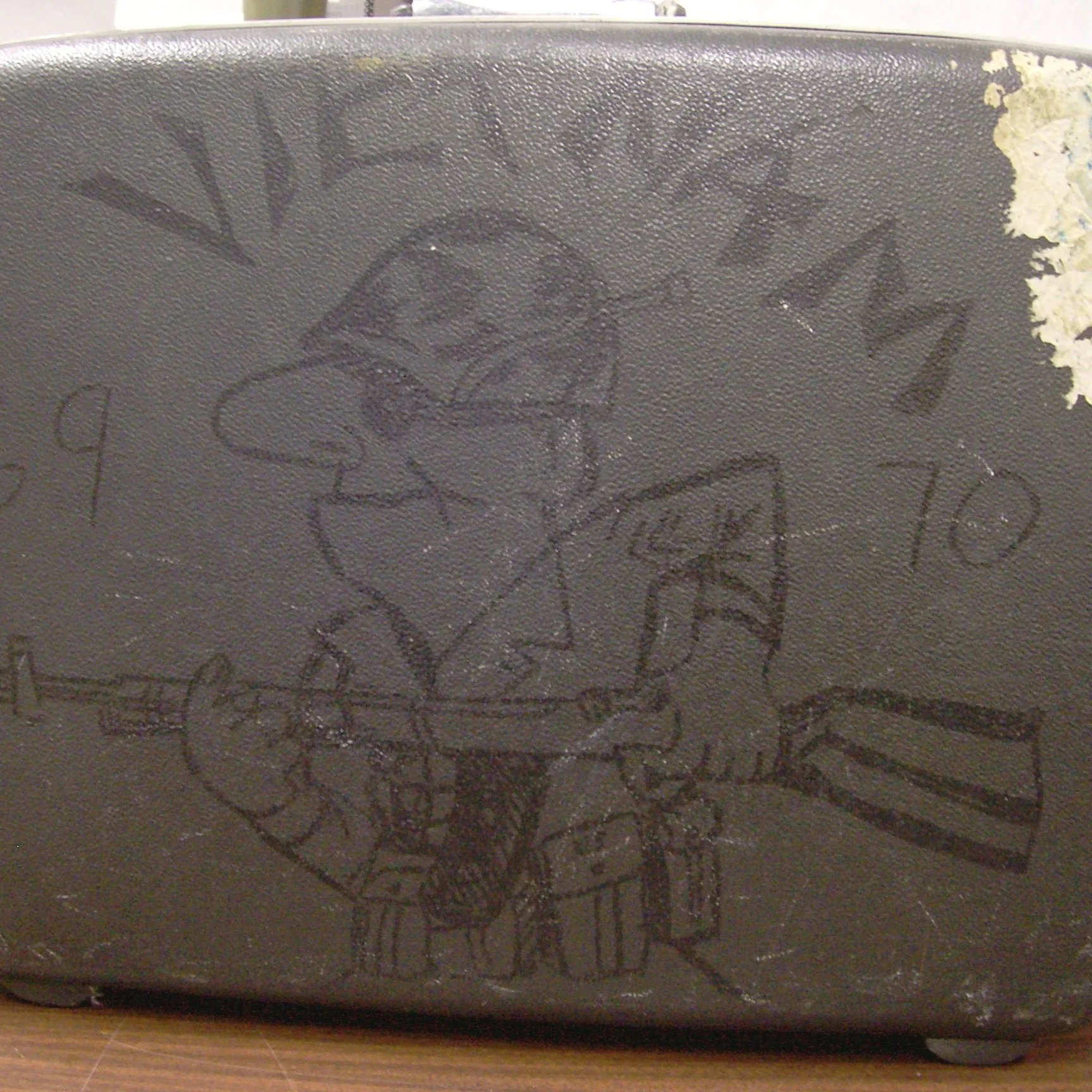
After his tour in Vietnam, Sam sat at a train station in Weisbotton, Germany for RR (rest and relaxation) when a fellow soldier drew “trench art” pictures using a magic marker on both sides of his suitcase. (Object ID 2007.1390.002)
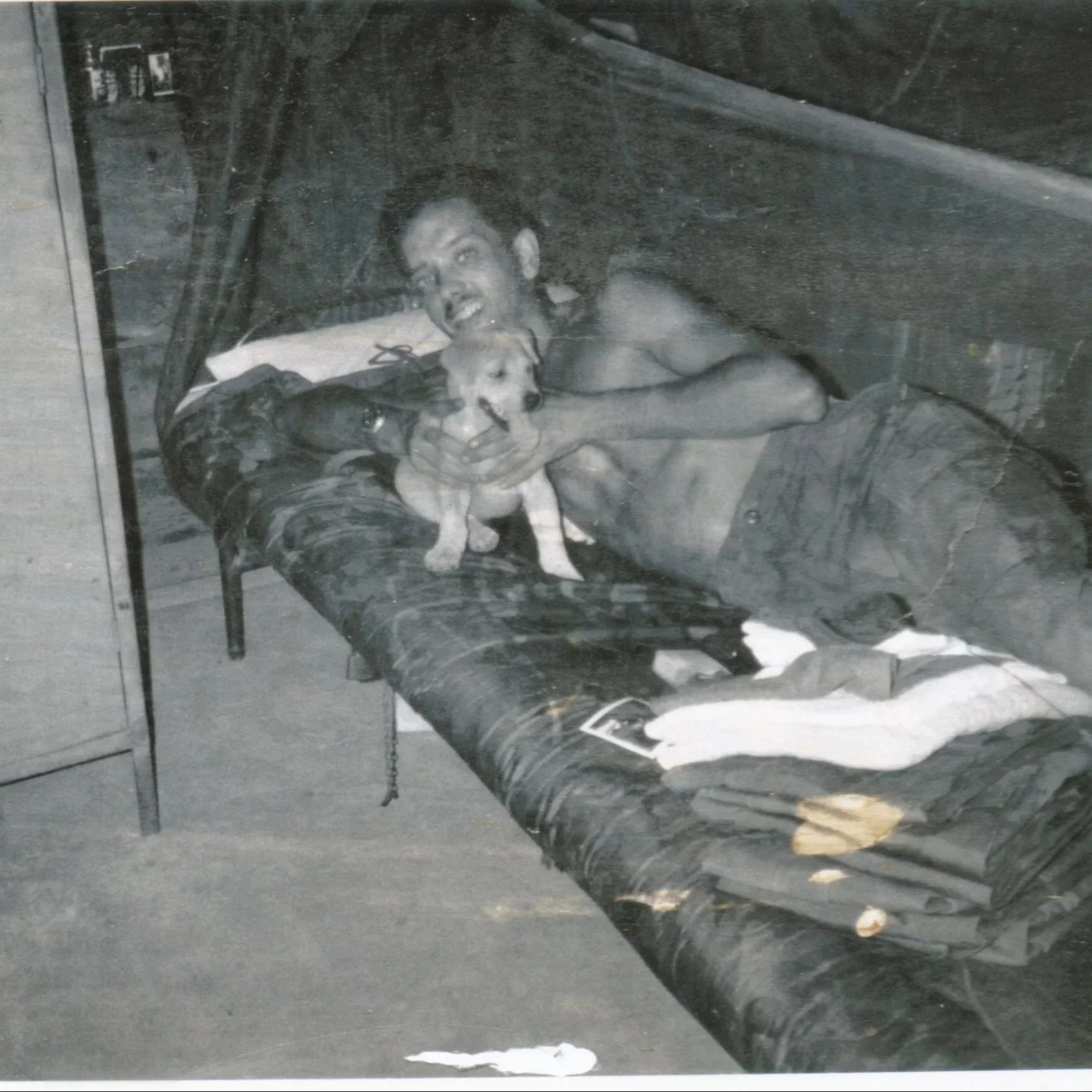
Sam made the most of every situation, including befriending a stray dog in Lai Khevn, Vietnam in 1969. Notice the mosquito netting he rolled up around his bunk, which is inside a large tent. (Object ID P2069.6.30)
Writing Letters Home
It’s time to pretend you’re part of Sam’s social circle. Who will you be? You can choose one of the following:
Mother
Father
Sister
Friend
You just received an envelope in the mail from Sam. Before you read it, think about how it feels to see his handwriting. How does the paper feel in your hands? What were the last things you knew about his time in Vietnam? What do you hope to learn in this letter?
Censorship and Self-Censorship
Letters were often censored by military authorities to prevent the disclosure of sensitive information. Soldiers also practiced self-censorship, avoiding details that might worry their loved ones or reveal military operations.
What type of information do you think Sam keep from you? What would he be worried about you knowing? What should YOU not tell HIM so he doesn’t get in trouble or worry about life at home? Does this feel like lying to you?
Open the letter Sam sent you and read it. Think about what he shared, then write back to Sam.
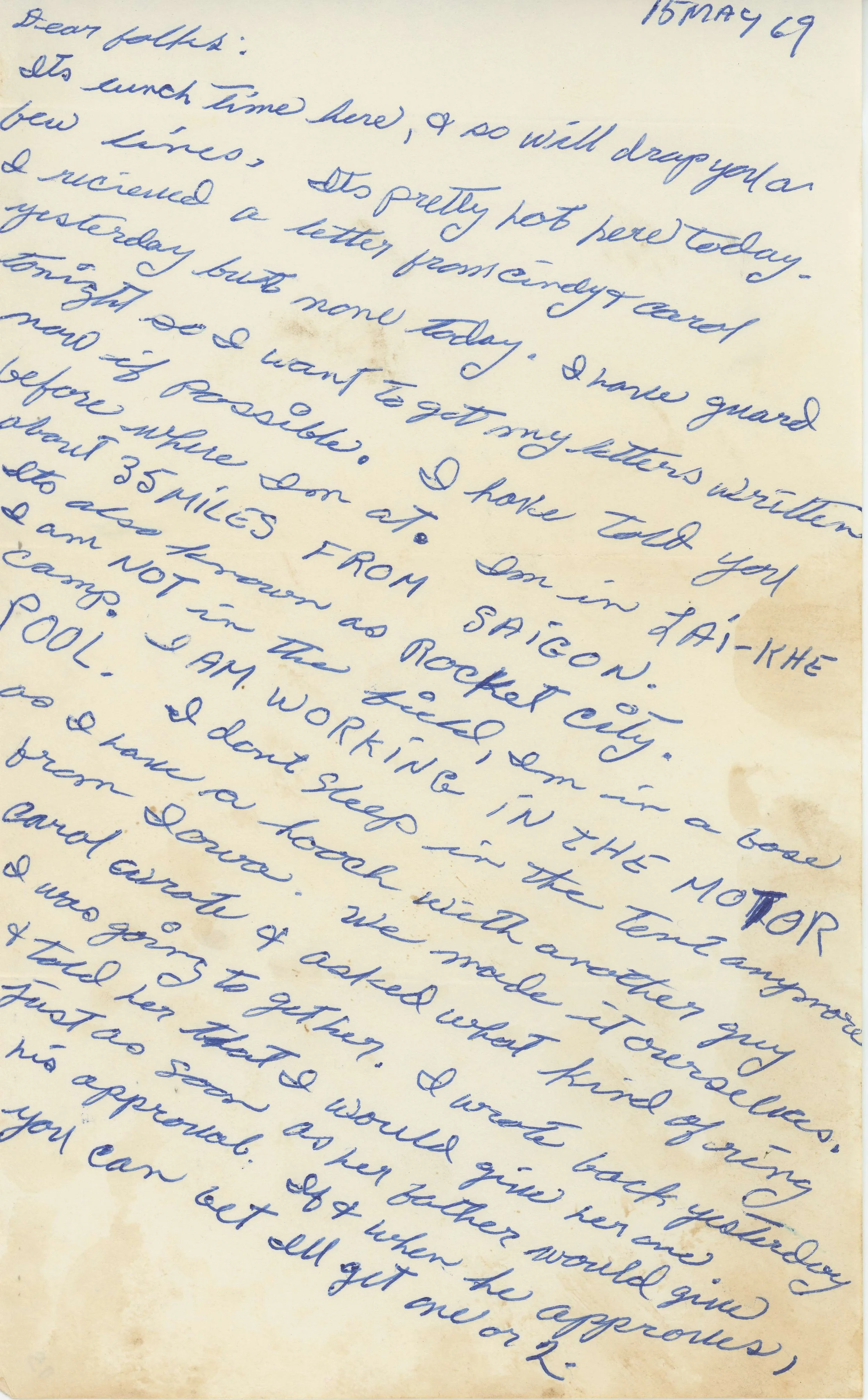
May 15, 1969
Dear folks,
It’s lunch time here, so will drop you a few lines. It’s pretty hot here today. I received a letter from Cindy + Carol yesterday but none today. I have guard tonight so I want to get my letters written now if possible. I have told you before where I am at. I’m in LAI-KHE about 35 MILES FROM SAIGON. It’s also known as Rocket City. I am NOT in the field, I’m in a base camp. I AM WORKING IN THE MOTOR POOL. I don’t sleep in the tent anymore as I have a hooch with another guy from Iowa. We made it ourselves. Carol wrote + asked what kind of ring I was going to get her. I wrote back yesterday + told her that I would give her one just as soon as her father would give his approval. If + when he approves you can bet I’ll get one or 2.
There isn’t much else I can tell you. She asked if I would take her out + get her drunk when I get back. I told her that there is no pleasure in it. I said that enough to make you feel good is ok, but not enough to make you lose your senses. I told her that I have only been drunk a few times + that you get sick + next day you have a bad hangover. Some of her friends told her that its really great when you’re drunk. I told her that they forgot to include the after effects. There isn’t anything else to say so will close. Hello to everyone.
Love Sam
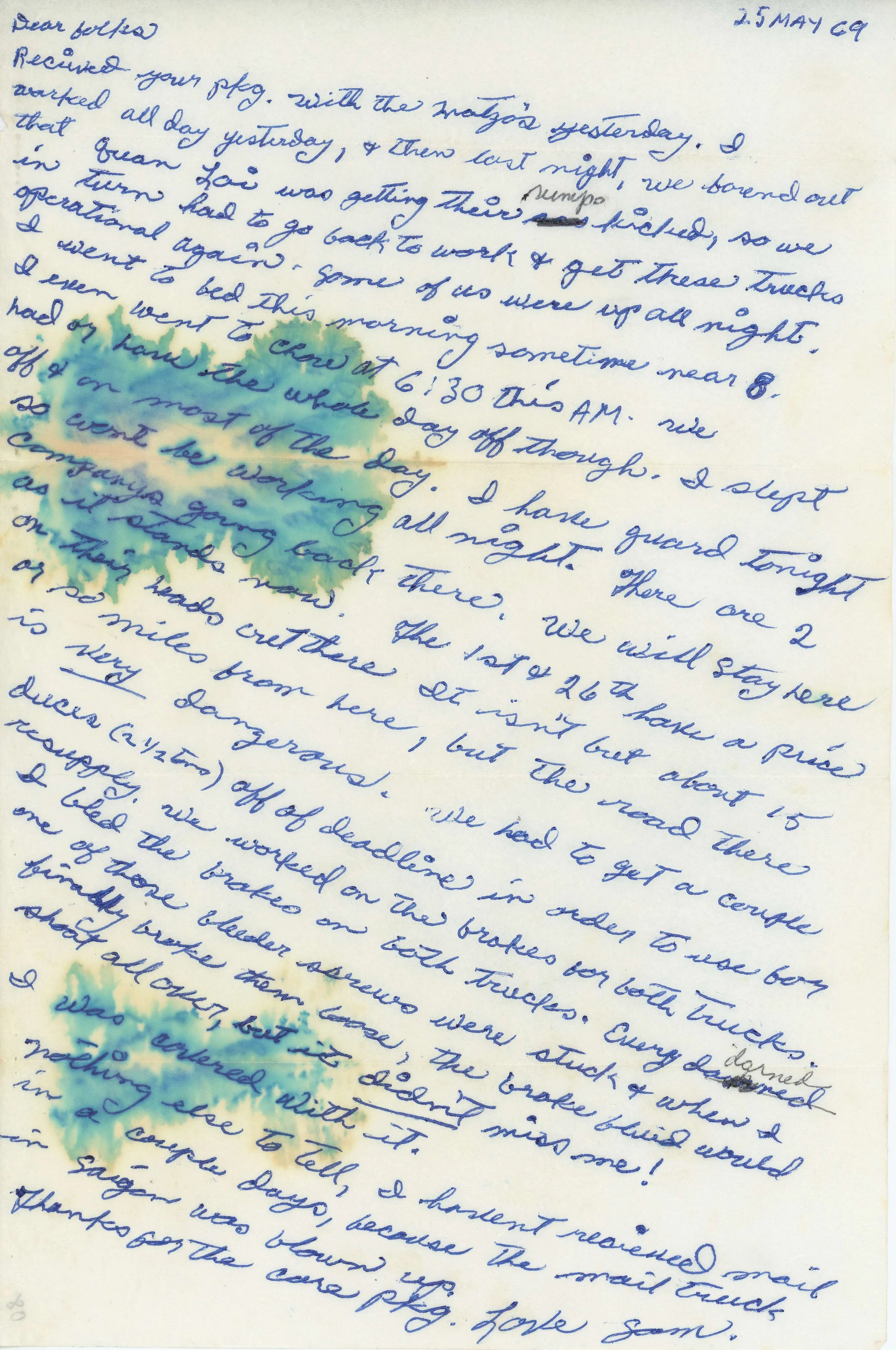
May 25th, 1969
Dear folks,
Received your pkg. with the [illegible] yesterday. I worked all day yesterday, + then last night, we found out that Quan Loi was getting their rumps kicked, so we in turn had to go back to work + get these trucks operational again. Some of us were up all night. I went to bed this morning sometime near 8. I even went to chow at 6:30 this AM. We had or have the whole day off though. I slept off and on most of the day. I have guard tonight so won’t be working all night. There are 2 companies going back there. We will stay here as it stands now. The 1st + 26th have a price on their heads out there. It isn’t but about 15 or so miles from here, but the road there is very dangerous. We had to get a couple deuces off of deadline in order to use for resupply. We worked on the brakes for both trucks. I bled the brakes on both trucks. Every darned one of the bleeder screws were stuck + when I finally broke them loose, the brake fluid would shoot all over, but it didn’t miss me! I was covered with it. Nothing else to tell, I haven’t received mail in a couple days, because the mail trucks in Saigon were blown up. Thanks for the care pkg.
Love Sam
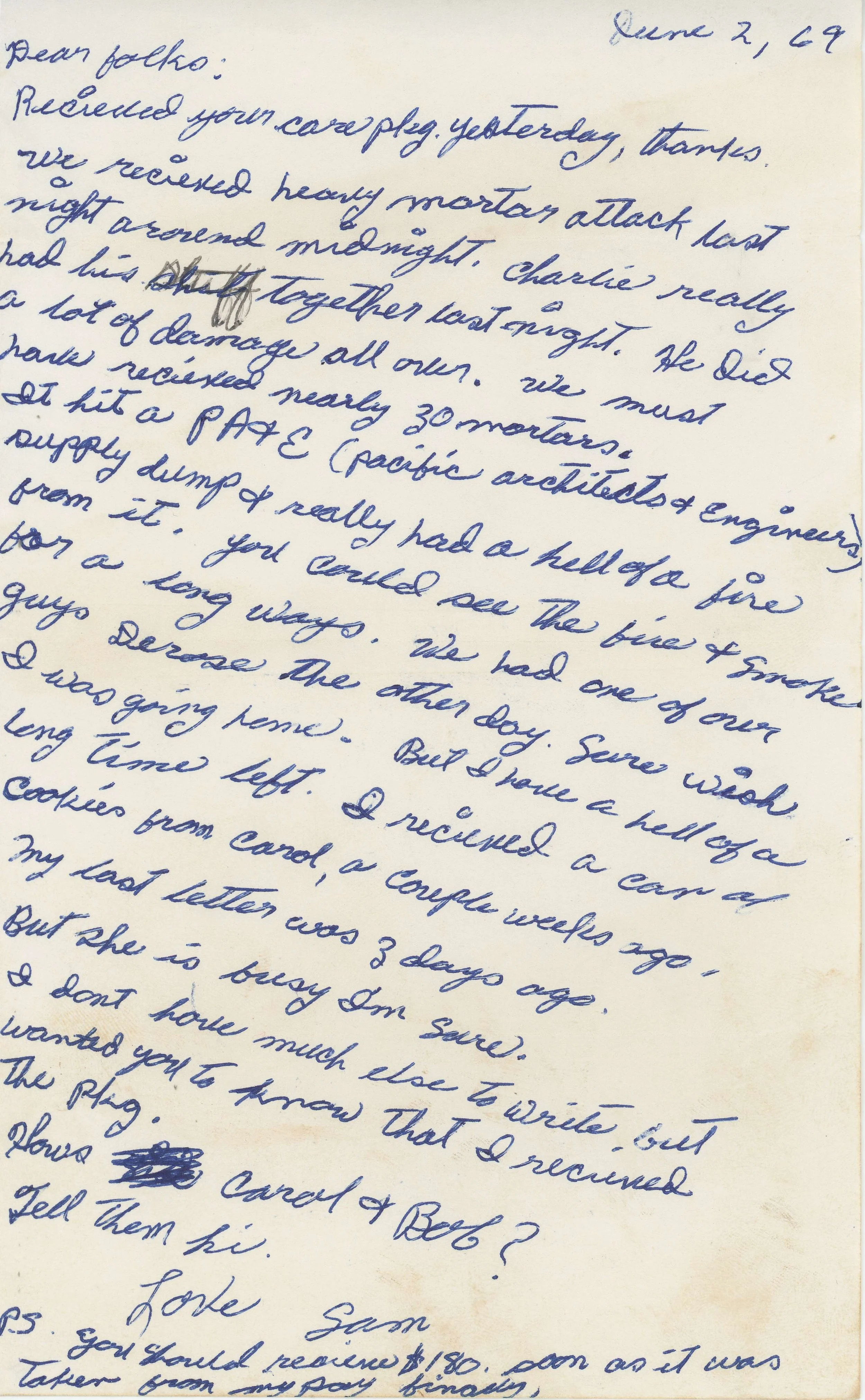
june 2, 1969
Dear folks,
Received your care pkg. yesterday, thanks. We received heavy mortar attack last night around midnight. Charlie really had his stuff together last night. He did a lot of damage all over. We must have received nearly 30 mortars. It hit a PA+E (pacific architects + engineers) supply dump + really had a hell of a fire from it. You could see the fire and smoke for a long ways. We had one of our guys [illegible] the other day. Sure wish I was going home. But I have a hell of a long time left. I received a can of cookies from Carol a couple weeks ago. My last letter was 3 days ago. But she is busy I’m sure. I don’t have much else to to write, but wanted you to know that I received the pkg. How’s Carol + Bob? Tell them hi.
Love Sam
P.S. you should receive $180 soon as it was taken from my pay finally.
Digging Deeper
Emotional Context: Soldiers often wrote under intense stress, fear, and homesickness. Their words may reflect anxiety, trauma, or attempts to reassure family members. Sometimes, they tried to downplay dangers to avoid causing distress at home.
Limited Perspective: Letters often offer a very personal, subjective view. They may not represent the full reality of the war, broader events, or the experiences of other soldiers.
Communication Delays: Letters took weeks to arrive, so events described were often already outdated. This lag could create confusion or misunderstandings between soldiers and those back home.
Cultural and Historical Context: Understanding the era’s political climate, anti-war sentiment, and soldiers’ backgrounds helps interpret the letters’ tone, content, and subtext.
Psychological Impact: War letters can reveal the psychological toll of combat, including signs of trauma, loneliness, and moral conflict, even if not stated explicitly.
Expressions of Camaraderie and Routine: Soldiers often shared stories of daily life, friendships, and mundane routines, which provided comfort and a sense of normalcy amid chaos.
Hope, Longing, and Connection: Letters were a crucial emotional lifeline. Pay attention to expressions of hope for the future, longing for home, and efforts to maintain relationships despite distance and adversity.
Sam was born and raised in South Minneapolis, the first of two children. Both his parents served in the Army Air Forces during World War Two; his father was a crew chief, and his mother was a teletype operator. After the war ended, his father worked as a printing press operator, and his mother worked as a janitor in the Minneapolis School District. Sam graduated from Roosevelt High School in 1965, at which point he unsuccessfully tried to enlist in the Army. He was medically disqualified from serving, but he was intent on making it work; he underwent two corrective surgeries, and after three years, he was allowed to enlist in March of 1968.
He attended basic training at Fort Dix, New Jersey, and was trained as a wheeled-vehicle operator. In 1969, he was sent to Vietnam and joined the 701st Maintenance Battalion in Lai Khe, about 50 miles north of Saigon. Sam worked on “All kinds of wheeled vehicles. Anything with tires under it. Trucks, trailers, Jeeps – that was pretty much all I ever handled.” Even though he worked in the motor pool, it was far from safe. Lai Khe, one of many military bases known as “Rocket City,” was frequently attacked by North Vietnamese artillery. “It lived up to its name.
It was pretty much an area where they liked to shell the compound a lot. It was pretty common practice that at any time of the day or night to have to run to the bunker, or something, for protection… There was a lot of weird things that would happen, too, where a rocket would come in and land. One time, we had one that came right through the roof of one of the buildings that was the radio guys’ repair shop. A shell came right through the roof and never exploded.”
Despite being a mechanic, Sam was nonetheless expected to maintain his combat skills and stand on guard duty at night. During those shifts, soldiers spent an entire night in a bunker, monitoring the perimeter of their base or encampment for signs of movement. He later recounted a particular story from one of those guard duty nights: “There was 3 of us assigned to one bunker. We were sitting on the back of the bunker, there, and I was sitting in the middle between the two other guys… all of a sudden, I started to scream very loud. I had gotten bitten by a scorpion right in the spine. I was right in between the other two guys, and I was the lucky recipient of the scorpion bite…”
He spent the majority of the night in the base’s Aid Station getting medical attention, and was given a choice by his officer: he could either go back to the bunker and finish his guard duty, or he could do it again the next night anyway. “I went back on guard duty for the rest of the night, but word got around the whole bunker line that somebody had gotten bitten, and everybody was afraid to even go around the bunkers then for fear of a scorpion, or a snake, or something.” The sting left Sam with permanent nerve damage for the rest of his life.
He spent six months in Lai Khe before transferring to Dau Tieng, a much larger base about 20 miles southeast, where he spent the remainder of his tour of duty. Dau Tieng, by contrast, was very well defended and much safer for the mechanics working in the motor pool. They also enjoyed better working conditions, being able to perform maintenance in tents instead of being completely exposed to the elements. By the time Sam was to be rotated out, his experiences in Vietnam had taken their toll.
He later recalled his frustrations with how the war was being handled. “I was scared. I was rather ticked off with the way things were going on, because we had areas that they could ambush us from, and we weren’t allowed to fire back at them… They had a lot of ‘no fire zones,’ where we weren’t allowed to fire into the area.” Such ‘no-fire’ zones were widely implemented in the aftermath of the My Lai Massacre in 1968, and included traditional burial grounds and cemeteries, villages, and anywhere else that might have had a civilian presence or cultural importance. “That didn’t apply to the Koreans, though,” Sam recalled. “The Koreans were feared
by the Vietnamese, because the Koreans would go out from the compound that they were at, from the bunker lines, and they’d go out looking for the enemy. They would do their body count by cutting off the ear, and that’s how they proved their body count, by the number of ears that they had. Unlike us. We’d just say, ‘Well, we’d seen this body or that body,’ and that was it.”
In 1970, Sam was rotated out of Vietnam and stationed in Wachenheim, West Germany, for a year. He was discharged from the military in March of 1971 and returned home to Minneapolis. He found work with the United States Postal Service, where he stayed for 31 years. Sam was very involved in veteran organizations in Minnesota; he was a Post Commander at the Ballentine Veterans of Foreign Wars (VFW) Post 246, and after moving to Anoka County, became a member of the Vietnam Veterans of America Post 470 after meeting fellow veteran Mike Clark at the Anoka County Fair. Sam was a member of the 470’s Honor Guard, which provided military honors at veterans’ funerals. Sam participated in an interview with the Anoka County Historical Society in 2003 and donated many of the letters he wrote in Vietnam. He passed away on January 23, 2018, at the age of 70.