
From NorthStar Stories: Honoring the Legacy of Ernest McDuffey
On September 5, 2026, people gathered at Veterans Memorial Park in Anoka to commemorate the 95th anniversary of the attempted lynching of Ernest McDuffy, a black American living in Anoka. For more information on Ernest, please reference our Hidden History online exhibit.
Transcript copied from Ampers.org, published on Sept 3, 2026
BRITT AAMODT: Almost a century ago, a young Black man named Ernest McDuffey narrowly escaped a mob that attempted to lynch him in Anoka, a northern Twin Cities suburb. For decades, that chapter of the city's history remained largely outside public memory.
VICTOR PALOMINO: Now, efforts are underway to ensure McDuffey's story is remembered and to shed new light on Minnesota's racial history. Reporter Jose Ozoria has the story.
[sound element: NSS MUSIC TRANSITION]
ERIK SKOGQUIST: Now, therefore, I, Erik Skogquist, by virtue vested in me as mayor of the city of Anoka, do hereby proclaim Saturday, September 5, 2026, as Remembrance Day in honor of Ernest McDuffey in the city of Anoka, and encourage all residents to reflect on our shared history and reaffirm our commitment to justice and human dignity.
ANOKA CITY COUNCIL/NAT SOUND: Proclaimed.
JOSE OZORIA: That's Erik Skogquist, the mayor of Anoka, a suburb northwest of Minneapolis. During a recent city hall meeting, for nearly a century, Ernest McDuffey's story remained largely forgotten. In 1931, an angry mob gathered outside the Anoka jail with an intent to lynch Ernest. Present-day Anoka is confronting this dark chapter in its history.
ED WHELING: As the day went on, the crowds got a little more riled up.
JOSE OZORIA: Ed Wheling is a writer, researcher, and former professor at Anoka Community College. He has spent years reconstructing what happened that September day in 1931, piecing together the story from contemporary newspaper accounts and other resources. Ernest McDuffey was a young Black garage mechanic living and working in Anoka. He was arrested after being accused of assaulting an eight-year-old white girl. Ernest maintained his innocence, but before a court could determine what happened, word of his arrest spread through the town, and people began gathering outside the jail where Ernest was held.
ED WHELING: There was one police officer at the jail. Too bad, told the jailer that there was a car accident on a bridge going over the Mississippi, and he should go go to that accident.
JOSE OZORIA: The accident was apparently a ruse to get the jailer to leave the jail unattended, but he became suspicious and turned back. By then, the situation outside the jail had escalated.
ED WHELING: About a mob of about 20 men started to, they had ladders. They put the ladders against the wall of the city hall to climb up to the second-floor jail. They were armed with shotguns and ropes.
JOSE OZORIA: Law enforcement arrived, and eventually the crowd dispersed. Ernest McDuffie was removed from Anoka and transferred to the Hennepin County Jail in Minneapolis. Ernest survived the mob, but he hadn't escaped the threat of violence. While being held in Minneapolis, Ernest faced another threat.
BRENDAN MCBRIDE: But they told him that if he pled not guilty, they were going to bring him back to Anoka, and that he would be murdered by a lynch mob if he came back here.
JOSE OZORIA: Brendan McBride is an attorney and chairperson of the Anoka Human Rights Commission. He says the depraved behavior Ernest encountered went beyond the attempted lynching.
BRENDAN MCBRIDGE: Maybe the bigger injustice here is that he was coerced under threats of being returned to be lynched into making a guilty plea. He was never given access to a lawyer. He had a three-minute trial with no evidence presented that resulted in a multi-year prison term.
JOSE OZORIA: Ernest McDuffey was sentenced to one to seven years at the St. Cloud Reformatory. Over the years, civil rights organizations fought for his release. Ernest applied for a pardon three times with the support of people like Cecil Newman, editor of the Twin City Herald, a Black newspaper. Still, the pardon board denied McDuffey's request all three times.
[sound element: NSS MUSIC TRANSITION]
JOSE OZORIA: The attempted lynching of Ernest McDuffie wasn't an isolated incident.
DR CHANTEL RODRIGUEZ: Lynching is the public killing of an individual by an angry mob without a legal trial and so lynching more often than not were classified as racial terror lynchings, which means that they were carried out with the explicit purpose of terrorizing and controlling racial groups.
JOSE OZORIA: Dr. Chantel Rodriguez, senior public historian at the Minnesota Historical Society, says that Minnesota was part of a broader national history of racial terror lynchings. Eleven years earlier, a white mob in Duluth lynched three Black men: Elias Clayton, Elmer Jackson, and Isaac McGhie. Local news articles covered the act of terror for generations. Racial terror lynchings have largely been associated with the American South. Dr. Rodriguez says that's an incomplete picture.
DR CHANTEL RODRIGUEZ: Lynching is distinctively Southern; it doesn't happen here, and yet the newspaper article itself is evidence of the fact that it is indeed happening here in Minnesota.
JOSE OZORIA: While the Duluth lynchings in 1920 inspired the state to pass strict anti-lynching laws in 1921, the mob that gathered in Anoka 11 years later showed that legislative action had not eliminated the racial hostility behind that violence. Ernest survived, but his story largely disappeared until Ed Wheling started doing genealogy research.
ED WHELING: I came across a news article about the attempted lynching of Ernest McDuffie. No one had heard about him. No one at the Minnesota Historical Society or local people. I talked to seniors in the area.
JOSE OZORIA: He found Ernest McDuffey's case reported in Minneapolis newspapers, Black newspapers, and publications outside of the state. The remarkable thing was that the story had gone unreported. It was that an event once considered newsworthy had virtually vanished from Anoka's collective memory. Eventually, Ed Wheling brought what he had found to the Anoka County Historical Society. Rebecca Ebnet-Desens is the society's executive director.
REBECCA EBNET-DESENS: We started this as a project with Ed, who just walks in the door one day and said, "I found this article in the newspaper. Why hasn't anyone ever talked about this before?" And it turned into a bigger project with the Anoka Ramsey Community College, part of what we called a Hidden History Series.
The historical society's research helped to put Ernest McDuffey's experience back into the context of Anoka's history, but Ed Wheling wanted the recognition to extend beyond the archives. He began advocating for a public remembrance and a permanent historical marker. For Wheling, the effort challenges a persistent idea about Minnesota's past.
ED WHELING: We're not isolated from the racial violence and racial injustice that permeated the country. That was throughout the country. We were no different in the other place.
JOSE OZORIA: The proposal eventually reached the Anoka Human Rights Commission. They unanimously supported the remembrance effort. The city of Anoka has since proclaimed September 5, 2026, Ernest McDuffey Remembrance Day. A public remembrance event is planned for September. The proposal for a permanent historical marker is still being pursued. Nearly 100 years after a mob tried to lynch Ernest McDuffey, Anoka cannot change what happened, but it seems to be working to make sure his story does not disappear again. For North Star Stories, I'm Jose Ozoria.
[sound element: NSS MUSIC TRANSITION]
VICTOR PALOMINO: The Minnesota Senate has also adopted a resolution recognizing September 5, 2026, as a day to honor the memory of Ernest McDuffey.
BRITT AAMODT: After the break, we explore how one of the nation's largest archives of Black literature helps us understand Minnesota's racial past. And we celebrate nearly a century of reporting by Minnesota's family-owned newspaper.
VICTOR PALOMINO: This is North Star Stories: Voices from Where We Live, produced by AMPERS, Minnesota's Community Radio Stations, with support from the State of Minnesota. We'll be right back.
[sound element: NSS Break Music]
[NSS Promo: "AMPERS, Minnesota's Community Radio Stations, is an association of 17 independent community radio stations in Minnesota, with over 300,000 listeners. We support our stations through revenue, training, and original news, arts, and cultural programs. AMPERS programming is produced for and by the communities in our stations' regions and aims to correct narratives about historically underrepresented groups. Check out what we're up to online at ampers dot org, on Instagram and Facebook."]
[sound element: NSS Break Music ends]
BRITT AAMODT: You are listening to North Star Stories. I'm Britt Aamodt.
VICTOR PALOMINO: And I'm Victor Palomino. History includes moments that are difficult to confront. Archives can help us understand the people and events that shaped our communities. At the University of Minnesota, the Givens Collection holds one of the nation's largest collections of African American literature and life. Its materials offer an important window into Minnesota's Black history and racial past.
BRITT AAMODT: We're joined now by Davu Underwood Seru, curator of the Givens Collection. He is also a writer, improvising musician, and composer. Welcome back to North Star Stories, Davu.
DAVU UNDERWOOD SERU: Thanks for having me.
BRITT AAMODT: How can the Givens Collection and what you collect there—literature, newspapers, archives—how can that help us understand events like the attempted lynching of Ernest and the wider history around these events?
DAVU UNDERWOOD SERU: The Givens Collection is the embodiment of you know many years of struggle. It's a record that was gathered by African Americans at a time in the 1980s, who are descendants, right, are carrying a lineage and a memory of racial violence against African Americans, including in the state. The lynching, of course, you know, as the story indicates, wasn't a phenomenon of the South, nor was slavery. There were slaves in Minnesota. Dred Scott, the most famous case, but there were others, and so there were sympathizers here, the record shows. The thing to me that's most striking in terms of the historical record on lynching is the number of photographs taken, gathered, collected at the time, disseminated throughout the country of postcards being circulated by members of the lynch mob throughout the country to intimidate, but also to celebrate. I mean, I'm struck also by the date. This is during the Great Depression. This is when you know there's a lot of pressure, sort of in most households, economic pressure is quite real for a lot of people. Three years later, you have Bloody Friday in Minneapolis. State violence against laborers, workers. I mean, this is a very crucial moment in our sort of recent history. This, which is to say, the Givens Collection is both a record but also evidence of the effort to historically counter the silences, right? That as the article or the story talked about, this sort of silence that's willed, right? This is an effort to bury a shameful experience, an event by people who know better.
BRITT AAMODT: You know, with Ernest McDuffey, that memory has always been there. But now we're seeing that it's getting, it's coming into mainstream memory. Does it matter, you know, that it's coming into the mainstream? That it's you know, and how do we teach students about this history without retraumatizing them?
DAVU UNDERWOOD SERU: Well, we have to talk about it. We have to do it together, and we have to care for one another as we have the conversation. And by that, I mean, when you ask about how do we care for trauma? My immediate thought was for traumatizing, say, African American youth or people who don't identify with the mainstream of American culture and see themselves potentially as receiving a similar faith them and their people. But then I thought about my experience in the classroom over the years and how we talk about lynchings in this as a sort of tradition in this country. So there's this discourse in our current you know at the at the time about white guilt conversations about it a barrier to overcoming it when people are either in such denial about the sort of crimes against Black people because they are close to the oppressor in that situation, and then those who, by virtue of just having you know by having been born white and without being able to help it, but are sympathetic to the freedom struggle, don't want to confront it because it makes them feel bad. In either case, the objections to having the conversation, I argue, are evidence that people know better and that the feelings that they're running from when confronted by the fact of history, the feelings in their body that they would rather not feel is evidence, I would argue, of the possibility for their redemption. That they are good. They know right from wrong.
BRITT AAMODT: Your position at Givens Collection at the University of Minnesota, it puts you in touch with a lot of our youth. What kind of questions do they bring to you? What do they want to know?
DAVU UNDERWOOD SERU: Quite frankly, often they're brought to me by someone who understands the value of history and archives, and they expect to hear bad news. You know, which is partly why they, some of them, are not interested in history, or they avoid it. But at an archive like the Givens Collection, you understand that the bad news is always countered, right? By efforts to not only survive but thrive. 1931, the height of the Klan, there are still Black people in in the Twin Cities and elsewhere in the state who are creating community, who are putting on plays and musicals, and are hosting events, dances, and you know soldiers, you know veterans' balls and church gatherings, and we are thriving as a community. The Givers Collection again, we use the evidence of our historical past, not only we certainly not to shame any. But simply to testify on behalf of you know our ancestors and to show how brilliant they were in their responses to it, how they and they created pathways for us institutions, and we are the evidence.
BRITT AAMODT: How do you get people interested in learning this history and remembering it?
DAVU UNDERWOOD SERU: I talk about my family because it is so that it's not so abstract. I point literally point two places. Which direction is north? Right, that's where I'm from. Right, so ground them in reality and in the full presence of our bodies. Now to talk about the Phyllis Wheatley Settlement House in North Minneapolis and its role during the Jim Crow period. Here to talk about Pilgrim Baptist Church in Rondo in Saint Paul. I talk about the smiling faces and I show them what you find in the photographs of Charles Chambliss at the Minnesota History Center from the 1970s and 80s that demonstrate and evidence through images something different than marching, being lynched, right, in Minnesota. Instead, Black families at the parks, at the lake, at church, at weddings, at the clubs downtown, you know, making the Minneapolis Sound thriving, doing better than surviving together, and changing the way we thought about this state, having uncomfortable conversations as we also celebrate and with pride our achievements. That's necessary.
BRITT AAMODT: Well, thank you so much for spending time with us here today, Davu.
DAVU UNDERWOOD SERU: Thank you for having me yet again.
[sound element: NSS MUSIC TRANSITION]
BRITT AAMODT: Since 1934, the Minnesota Spokesman-Recorder has reported on and documented the lives of Black Minnesotans. It is Minnesota's oldest continuously operating Black-owned newspaper and one of the country's longest-running family-owned Black newspapers. The paper was founded by Cecil E. Newman, who built a vital platform for Black news, culture, civic life, and community advocacy.
VICTOR PALOMINO: Today, his granddaughter, Tracey Williams-Dillard, serves as the paper's CEO and publisher. She was recently inducted into the inaugural class of the Minnesota Black Chamber of Commerce's Minnesota Black Business Hall of Fame. Tracy, welcome to North Star Stories.
TRACEY WILLIAMS-DILLARD: Well, thank you, thank you for having me.
VICTOR PALOMINO: Ninety-two years of the Minnesota Spokesman-Recorder. First of all, congratulations! And for you personally, what this anniversary means, and what do you think it means for the newspaper's readers?
TRACEY WILLIAMS-DILLARD: Well, to me, what the anniversary means is it's been 92 years of a struggle, triumph, success, perseverance, and so many other words. But it also means more than anything is that we're able to continue to uplift and tell the stories of the community for 92 years. To me, that means a lot, and I think it means a lot to the community that there is a vehicle that hosts and holds and records and does the storytelling for this community that no one else does.
VICTOR PALOMINO: How has that transition been like through the years? Again, I was reading an article and said, like, when you were eight years old, you started getting involved with the newspaper. How did you see those moments, and how do you see the transition to what the news are reported today?
TRACEY WILLIAMS-DILLARD: The thing is that I never really paid attention was the whole transition because it's like, so you're the first they say, so you're the first to create the digital prospect of the paper, and I'm like, guess I never really looked at it that way. For the whole digital transformation of us doing, you know, going to social media more than anything, creating our podcast, it's been, it's, you know, and how people are receiving the news is different than it was when I took the paper on, and I like it as far as being able to get it to people faster.
VICTOR PALOMINO: Are you finding a new generation of Black reporters and editors and media creators that are getting, taking the legacy of the newspaper and the Black press here in Minnesota?
TRACEY WILLIAMS-DILLARD: I am actually. I've been been fortunate enough. Lately, there's been a lot of African American young women, particularly, that are starting to look into the journalism field and wanting to become more involved in the news. And so, as a result of that, I've been fortunate enough to be able to bring some younger writers on and some younger editors on, which is a blessing because they're able to help with some of the storytelling we're doing to embrace a younger readership while you still have, you know, the old guards that are you know around like myself that are you know still making sure we're holding down the older readers so we're not losing them.
VICTOR PALOMINO: So the newspaper has covered major moments in Minnesota's history. Are there any particular stories or community issues that really stand to you during all these years?
TRACEY WILLIAMS-DILLARD: I think one, and it's funny because it's actually coming full circle again, and we're now getting ready to start really leaning in on this story. But the whole Hollman Decree that was happening over north, where they were tearing down all the projects, and they're building all the new housing units over there. That same housing unit is now under scrutiny once again, but from a different perspective because now it's like the properties are not being kept up. So that story still has a lot of legs in it that we're about to really start embarking on to find out more about how we can once again be a voice in the community, being able to be the voice for people that were displaced, and then we were able to make sure that they had an opportunity to come back. Always is a story under my legacy that I'll never forget.
VICTOR PALOMINO: And for future generations, and for the historians of the future.
TRACEY WILLIAMS-DILLARD: Absolutely.
VICTOR PALOMINO: After 92 years, what do you hope the Minnesota Spokesman-Recorder will continue to provide to Minnesota's Black community?
TRACEY WILLIAMS-DILLARD: I want to continue to preserve our history with the truth, and you know, telling the narratives and the stories that aren't being told anywhere else, and when they are told, the portion that's told is not the full story. And I want to make sure we're able to still be here to tell the full story. And then also with it, I've had a lot of other mainstream entities that have done news over the years, and they've been amazed over the fact of the stories, how we've seen them are different than how they've seen them, and they're like, you know, looking at it from your perspective, I truly do see a concern. Versus, I didn't see this story until I seen it in your paper because it wasn't a story to them, and we want to continue to make sure that people see that and understand the importance in the stories we do.
VICTOR PALOMINO: Well, Tracey, thank you again for your time and for sharing all this information with our listeners.
TRACEY WILLIAMS-DILLARD: Thank you so much for having me.
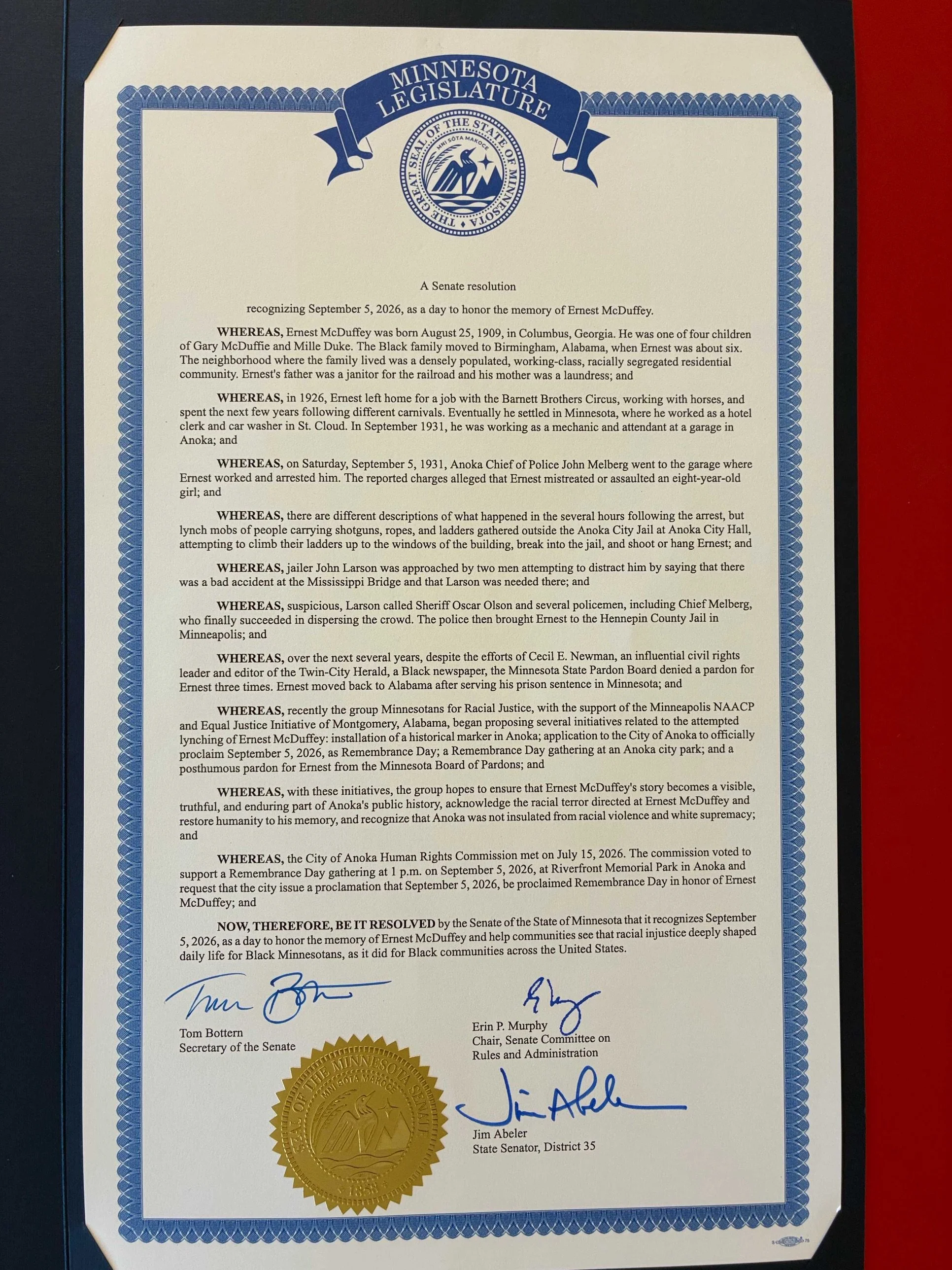
Proclamation signed by Senator Jim Abeler recognizing September 5 as Ernest McDuffy Remembrance Day. The City of Anoka mayor, Erik Skogquist, signed a similar proclamation.
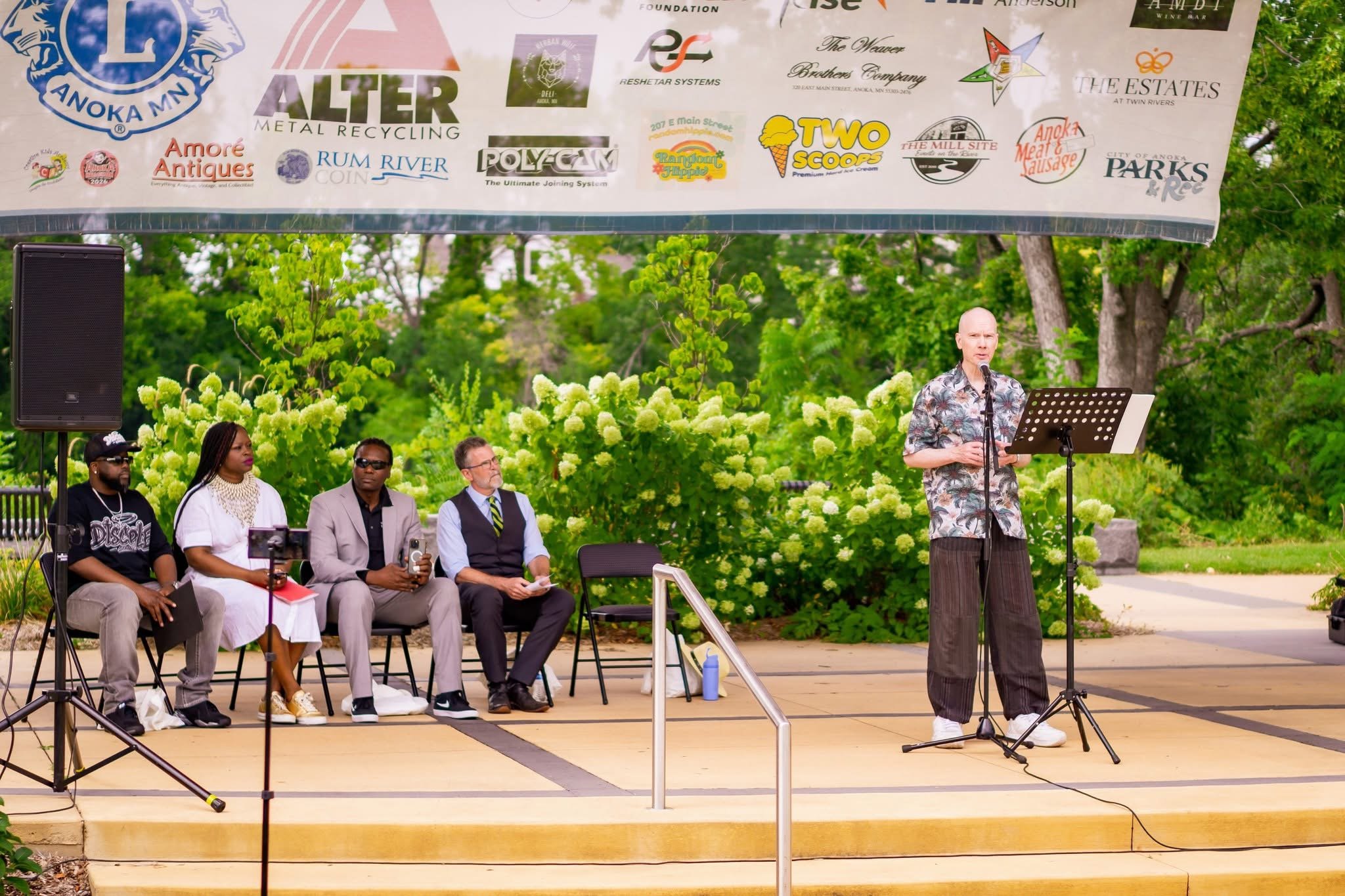
Organizer Ed Wheeling speaking at the Remembrance Day with additional speakers present on stage.