
Lynn Bower
Lynn Bower served in the United States Army Nurse Corps as an emergency room nurse and was deployed to Vietnam from 1970 to 1971. Most of her service took place at the 24th Evac Hospital in Long Binh, the closest evacuation hospital to Saigon, but it was cut short due to pregnancy. She grew up in northeast Minneapolis, the oldest of three children. Her father, originally from Red Wing, MN, was a World War II veteran who served as a paratrooper in the 101st Airborne Division and saw action during the siege of Bastogne, Belgium, in the Battle of the Bulge. Her mother, originally from Zumbrota, MN, was a registered nurse who cared for terminally ill children out of her own home, which Lynn and her siblings assisted with.
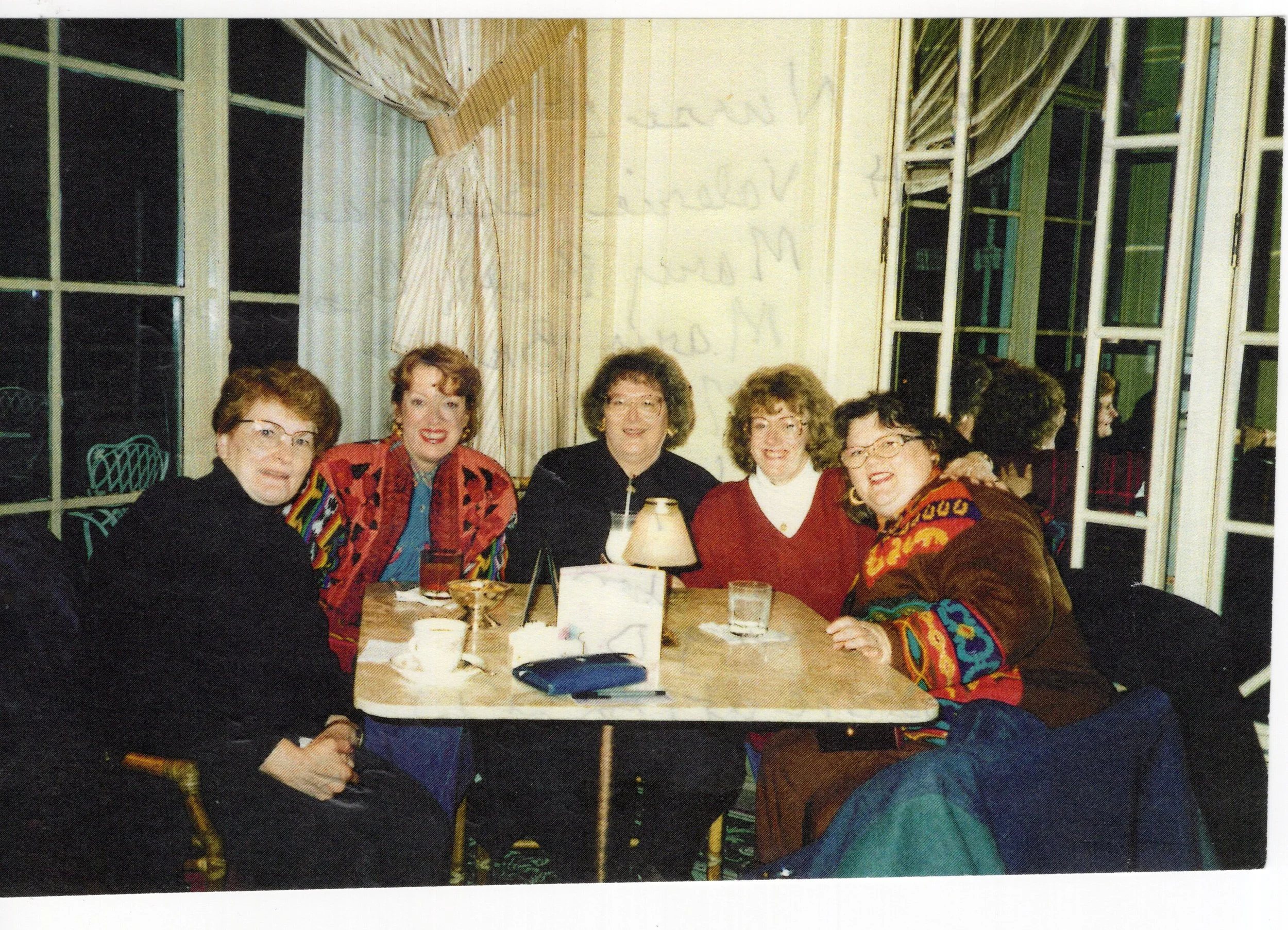
2025.2114.002a - Photograph is of five women sitting at a table. Description on back reads:
"Vietnam Nurse Group
From left: Valerie Buchan
Mary Beth Crowley
Mary Breed
MaryLu Brunner
Lynn Bower
1993 Washington DC Dedication of Women's Memorial"
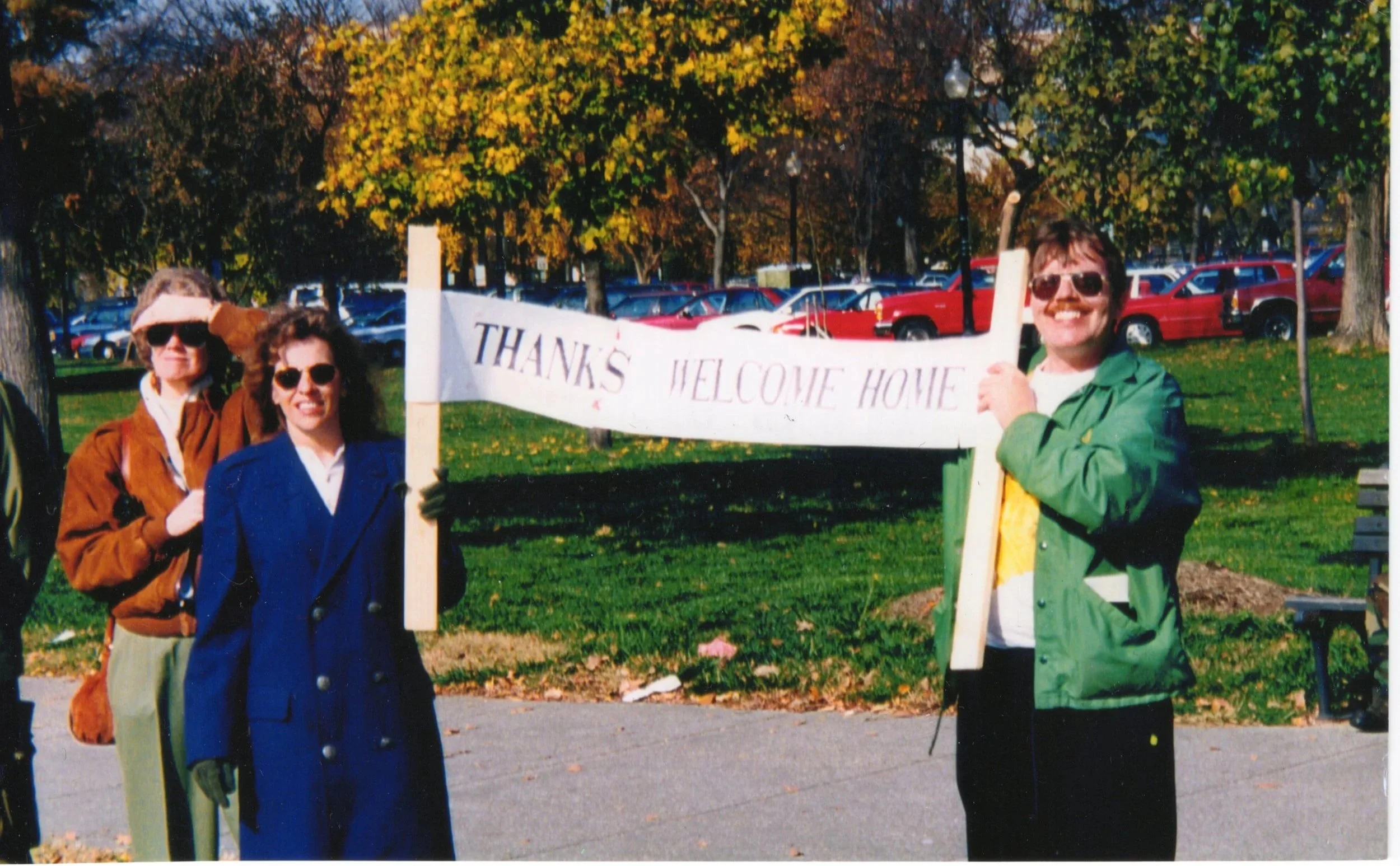
2025.2114.003b - Photograph is of a small group of people standing outside. The two central subjects are holding a sign that reads “Thanks, Welcome Home.”
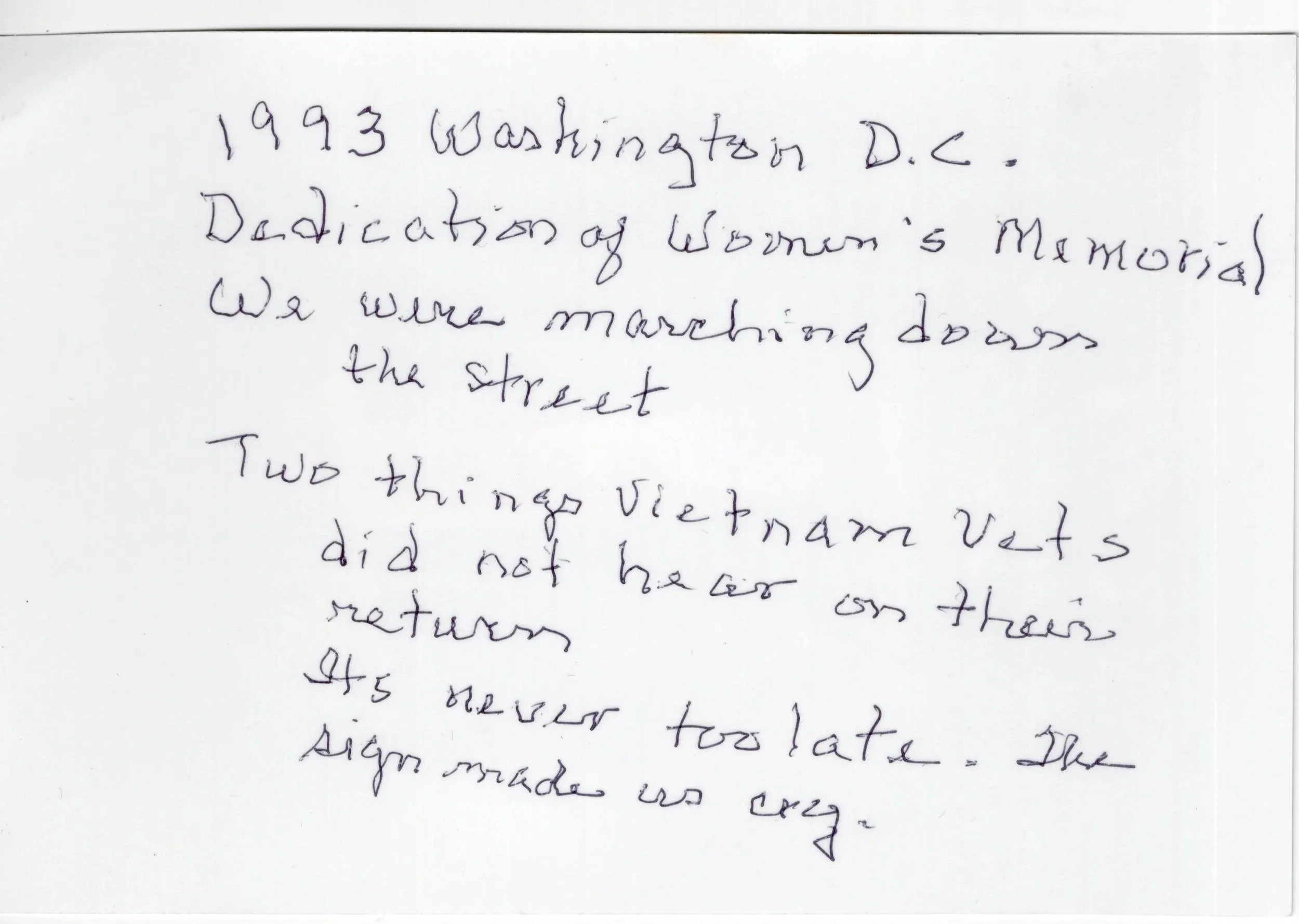
"1993 Washington, D.C. Dedication of Women's Memorial
We were marching down the street
Two things Vietnam Vets did not hear on their return
It's never too late. The sign made us cry."
Pregnant and Serving
It’s time to pretend you’re part of Lynn’s social circle. Who will you be? You can choose one of the following:
Mother
Father
Boyfriend
Friend
It’s 1970, and Lynn just told you she is pregnant but still enlisted in the Army with orders to deploy to Vietnam. What advice would you give her? How could you support her through this experience? What fears would you have for her?
Digging Deeper
birth control and marriage
Lynn discusses not being able to obtain birth control because she isn’t married. Here are some reasons why that happened:
1. Societal Norms: Often, sexual activity is seen as acceptable only within marriage. The purpose of birth control was, therefore, seen as a means to regulate reproduction within legal relationships.
2. Legal Restrictions: Laws often prohibited unmarried women from accessing contraceptive methods. These laws were rooted in the belief that single women should not engage in sexual activity and, thus, should not need birth control.
3. Moral and Religious Beliefs: Many communities hold strong moral and religious beliefs that influence laws regarding sexuality. These beliefs often view premarital sex as immoral, leading to restrictions on contraceptive access for unmarried individuals.
4. Control Over Women's Bodies: Restricting access to birth control for unmarried women can also be seen as a means of exerting control over women's sexuality. By tying access to marital status, society perpetuated the notion that women should only be sexually active within the bounds of marriage.
The Army offered to send Lynn to Japan for an abortion so she could continue her service. How does that make you feel? Do you think she felt the same way?
Lynn graduated from the now-defunct University High School in 1966 and spent a year at the University of Minnesota. However, she quickly found she didn’t care for large classes or the teaching methods, and her mother helped her get an interview at Saint Barnabas Hospital School of Nursing. She was accepted and attended the school for three years, graduating in 1970. Her parents paid for her first two years there, and Lynn decided to join the Army to pay for her third year. She spent that summer working as a nurse at Metropolitan Medical Center and shipped out for basic training at Fort Sam Houston in Texas in the fall. From there, she went to Fort McClellan, Alabama, for post-surgical training, and then again to Fort Bragg, North Carolina, for OR training. At that point, Lynn had gotten pregnant by her then-boyfriend, an Army Airborne trooper who had already spent two years in Vietnam. She had informed the Army of her pregnancy, but was given orders for Vietnam regardless.
Lynn recalled a particular incident from before she shipped out: “There was a couple, a married couple in OR school, Gordon and Mary Metzger. And Mary and I went to get birth control at the same time… I was refused because I wasn't married. Mary was refused until she got Gordon's signature on a piece of paper. And then when we went back and said, ‘okay, you know we really were going to Vietnam, we need this.’ …We went to see the pharmacist, just thinking, well, she had her signed paper. He wouldn't give it to us. He said, ‘Get it in Vietnam.’”
She arrived in-country in 1971 and was assigned to the ER at the 24th Evacuation Hospital in Long Binh, South Vietnam (not far from Saigon). Her boyfriend had re-enlisted and returned to Vietnam at the same time, stationed at the nearby Bien Hoa Air Base. He visited Lynn at the 24th Evac several times, but he was sent back to the US after developing a knee abscess, leaving Lynn alone in-country. Around the same time, Lynn met with the hospital’s commanding officer and chief nurse about her pregnancy, which was three months along. Her senior officers offered to send her to Okinawa, Japan, to get an abortion and continue working, but she denied the offer. As a result, she was to be sent back to the US and discharged. Lynn was sent to the 90th Replacement Battalion in Long Binh for outprocessing.
While there, however, she ran into further issues: her pregnancy was causing her to fail the required drug tests. “They held me in-country because they believed that I was using… So finally one of the helicopter pilots that I had met when I was at the 24th Evac, well, he came over to see how I was doing… And he knew I was pregnant, you know, and I said, I can't get out. I keep failing the drug test. So he went back over to the 24th Evac and he got the reverend… I wasn't privy to any of this, but must have come over and talked to the commander at the 90th Replacement, because then I got assigned to a flight, and got out of the country.” She was flown in to Fitzsimons Army Hospital in Aurora, Colorado, where she reconnected with her then-boyfriend. While there, Lynn worked in the hospital’s Central Medical Supply (CMS), and the two married in the hospital’s chapel. She was discharged from active duty and gave birth to her son, Troy, in 1972.
Lynn’s marriage ended in divorce, and she was left to raise her son alone. She returned to Minnesota and found work as a nurse, transferring among several hospitals in the state, including Lake City Hospital, Hastings State Hospital, and Saint Mary’s. She stayed in the Army Reserves until 1986, having spent 16 years in the Army Nurse Corps.
She later connected with other women who had served in the Vietnam War, which helped her manage her traumas and struggles. Lynn participated in an interview with Kim Heikkila through the Minnesota Historical Society in 2006 and again with Jo Rohady through the Anoka County Historical Society in 2025.